


Trending Now
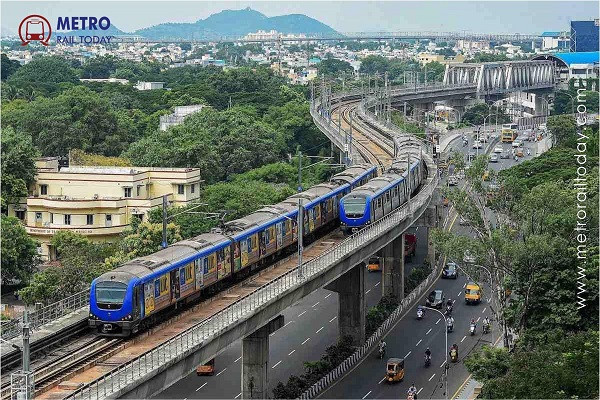 Tamil Nadu reassesses Metro Expansion in Coimbatore, Madurai, Salem, Tiruchirappalli and Tirunelveli
 CMRS issues safety clearance for proposed Rolling Stock trainsets for Mumbai Metro 4 and 4A
 Japanese Delegation visits KRIDE to explore Bengaluru Suburban Rail Project opportunities
 GMRC issues ₹879 crore Civil Tender for Airport Extension under Ahmedabad Metro Phase 2A
 Global Mobility Leaders Alstom and Siemens become Corporate Member of Chamber of Railway Industries
 L&T-MHI JV wins contract for Automated People Mover at Dubai’s Al Maktoum International Airport
 Delhi Metro Rail Network to expand to 695 km by 2047, Six new RRTS Corridors planned
 HÜBNER at InnoTrans 2026: Global rail expertise and local capability for India’s Next-Gen Mobility
 Australia shortlists three firms/consortia for Sydney–Newcastle High Speed Rail Project
 MRVC set to procure 238 AC Vande Metro Trainsets worth ₹19,293 crore from Indian Railways
Tamil Nadu reassesses Metro Expansion in Coimbatore, Madurai, Salem, Tiruchirappalli and Tirunelveli
MRT Online Desk
Posted on: 2026-08-27 10:05:00
Viewer: 56
Comments: 0
Country: India
City: Chennai
Chennai, India (Rail & Metro Today): The Tamil Nadu government has undertaken detailed feasibility studies for introducing Mass Rapid Transit Systems (MRTS) in Coimbatore, Madurai, Salem, Tiruchirappalli and Tirunelveli, as the state examines solutions to rising traffic congestion and growing urban travel demand.
According to the Special Initiatives Department Policy Note 2026-27, tabled in the Tamil Nadu Assembly, the studies have resulted in different outcomes for the five cities, with proposals at various stages of consideration.
Centre Returns Coimbatore and Madurai Metro Proposals
The Detailed Project Reports (DPRs) for Coimbatore and Madurai were prepared by Chennai Metro Rail Limited (CMRL) and subsequently recommended to the Central government for funding under a 50:50 equity-sharing arrangement.
However, the Ministry of Housing and Urban Affairs (MoHUA) recently returned the proposals. The Centre indicated that it had no objection to implementing an at-grade or elevated Bus Rapid Transit System (BRTS) in the two cities.
The development could lead to a reassessment of the proposed mass transit model for Coimbatore and Madurai, although the policy note does not indicate whether the state government will modify the proposals or pursue an alternative implementation strategy.
Salem DPR Under Consideration
For Salem, the Detailed Feasibility Report is currently under consideration.
Meanwhile, Tirunelveli did not qualify for the implementation of a suitable MRTS following the feasibility assessment.
In the case of Tiruchirappalli, further action has been deferred due to the substantial committed financial liabilities associated with the ongoing Chennai Metro Rail Phase-II project.
The state government's decision to conduct feasibility studies across multiple Tier-II cities reflects Tamil Nadu's broader effort to identify appropriate mass transit systems based on local travel demand, financial viability and future urban growth.
Chennai Metro Phase-II Extensions Proposed
CMRL has also submitted DPRs for two major extensions under the future expansion of the Chennai Metro network.
The first proposal involves the extension of Corridor-4 from Poonamallee Bypass to Sunguvarchatram via Sriperumbudur.
The second proposal aims to provide metro connectivity from Koyambedu to Pattabiram and the Outer Ring Road via Ambattur and Avadi.
The Tamil Nadu government has accorded in-principle approval to both corridors and recommended them to the Government of India for approval. The proposals are currently under consideration by the Centre.
Chennai Airport–Kilambakkam Metro Extension Awaits Central Approval
The proposed Chennai Metro extension from Chennai Airport to Kalaignar Centenary Bus Terminus (KCBT) at Kilambakkam has also progressed through the DPR stage.
The original DPR had to be revised after the Highways Department proposed an elevated road along the same corridor. Following this, CMRL prepared and submitted a revised DPR.
The revised proposal was approved by the Tamil Nadu government and forwarded to the Central government for approval, funding and external financial assistance.
With approval from the Government of India still awaited, the Airport–Kilambakkam extension remains another important proposal for expanding Chennai's metro connectivity towards the southern suburban growth corridor and the city's major intercity bus terminal.
The latest policy note highlights Tamil Nadu's evolving urban mobility strategy, with the state simultaneously assessing Metro and BRTS solutions for Tier-II cities while continuing to pursue major network extensions for the rapidly expanding Chennai Metro system.

MRT Online Desk
Metro Rail Today is an authentic and global news provider for the Rail & Metro industry from and around the world.