


Trending Now
 Modern Trainlines and the End of Coal Trains: Why Rail Networks Have Moved Forward
 Siemens Bags Order from Titagarh Rail Systems for Pune Metro Extension Trainsets
 Titagarh Rail Systems becomes Corporate Member of Chamber of Railway Industries (Rail Chamber)
 World Bank approves ₹1,400 crore Civil Tender for Gurugram Metro Phase 2
 Bi-RIDE invites ₹200 crore Tender for Soladevanahalli Depot of Bengaluru Suburban Rail Project
 GHV India awarded ₹107.79 crore Civil Contract for Lucknow Metro East-West Corridor
 Pune Metro Line 3 set to launch First 12-km Section on 15 July 2026
 DMRC gets approval to Fell or Transplant 364 Trees for Central Vista Metro Corridor under Phase IV
 ₹4.5 Lakh crore Metro Rail Investment reaches less than 5% of Urban Population in India
 West Bengal plans to launch Water Metro Systems in Kolkata
How Delhi Metro is reimagining urban architecture for a sustainable public transport?
MRT Online Desk
Posted on: 2025-09-17 09:15:00
Viewer: 25,796
Comments: 0
Country: India
City: New Delhi
As Delhi evolves into one of the world’s most complex megacities, the task of building urban infrastructure has moved far beyond questions of scale and speed. Today, the real challenge lies in integration—how transport systems merge with the city’s social, spatial, environmental and historical fabric. At the heart of this transformation is the Delhi Metro Rail Corporation (DMRC), which over the last two decades has redefined the role of metro rail from a mobility solution into a powerful instrument of urban regeneration.
With more than 390 km of operational network, daily ridership touching 6–7 million passengers, and Phase IV adding another 103 km by 2026, DMRC’s footprint today extends deep into Delhi’s everyday life. The corporation’s design philosophy now reflects a mature understanding that metro systems must be energy-efficient, inclusive, technologically advanced and, above all, people-centric.
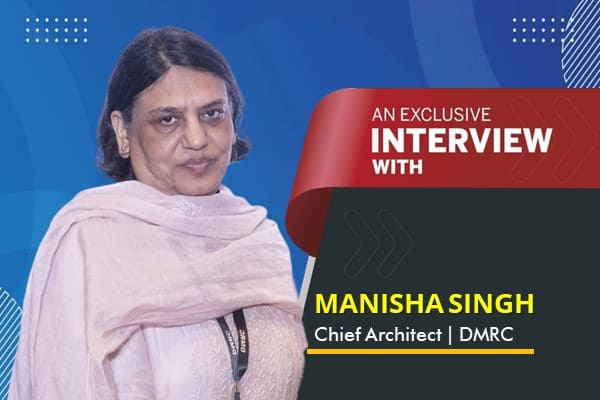
With over three decades of professional experience, Manisha Singh brings a rare combination of architectural expertise, academic leadership and global exposure to her role at Delhi Metro Rail Corporation (DMRC). A qualified design professional, architect and educationist, she has worked extensively across India, the UK and the UAE, gaining deep insights into diverse urban and transit environments.
Her academic and professional training spans multiple countries, including India, Sri Lanka, the UK, the USA and the UAE. Over the years, she has developed a strong reputation for enhancing spatial and user value in institutional, transit and industrial environments, while leading complex, cross-functional project teams.
At DMRC, she has recently taken on the role of Chief Architect – Business Development, where she is actively contributing to the design and development of metro stations, Transit-Oriented Development (TOD) projects, Multi-Modal Integration initiatives and property development consultancy. Her strengths in curriculum development, strategic management and execution of large-scale transit infrastructure projects continue to influence DMRC’s evolving architectural vision.
In an exclusive interaction with Metro Rail Today, Manisha Singh, offers a detailed view into how architecture, sustainability and digital tools are being strategically deployed to shape a future-ready metro network for the National Capital Region.
Architecture Rooted in Urban Context
One of the defining principles guiding DMRC’s design approach is contextual integration. Metro stations, depots and corridors are conceived as extensions of the city rather than isolated engineering structures. Each project begins with detailed site studies examining local heritage, traffic patterns, pedestrian behaviour, land use and community needs. The intent is to ensure that metro infrastructure complements the urban environment while delivering high operational efficiency.
This philosophy is particularly evident in heritage-sensitive areas such as Kashmiri Gate, where DMRC has successfully blended modern transit infrastructure with the surrounding historic precinct. Architectural elements inspired by local materials and motifs, including sandstone cladding, allow the station to visually align with its context while managing footfalls of over nine lakh passengers daily through efficient layouts and clear circulation paths.
Such design sensitivity has enabled DMRC to navigate one of Delhi’s toughest challenges—introducing large-scale infrastructure into a city layered with history, dense habitation and regulatory constraints.
Stations as Multi-Modal Urban Hubs
DMRC’s architectural thinking has increasingly shifted towards multi-modal integration, transforming stations into comprehensive mobility hubs. Instead of functioning merely as boarding points, stations are designed to facilitate seamless transitions between metro services, buses, autos, pedestrian networks and private vehicles.
Locations such as Hauz Khas, Majlis Park and Chhatarpur demonstrate this approach in practice. At Chhatarpur, a pilot multi-modal integration project has introduced structured parking, organised bus bays and clearly demarcated pedestrian pathways, significantly reducing congestion and improving last-mile connectivity. These interventions directly support the NDMC’s Comprehensive Mobility Plan by encouraging modal shift and discouraging excessive private vehicle use.
Through such integration, DMRC is quietly reshaping commuter behaviour while reinforcing the metro’s role as the backbone of Delhi’s transport ecosystem.
Aesthetic Balance in Elevated and Underground Corridors
Elevated metro corridors often face criticism for visual intrusion in dense urban landscapes. DMRC has responded by incorporating façade treatments, landscaping, noise barriers and public art into its elevated designs. In Phase IV corridors, including the Janakpuri West–RK Ashram extension partially opened in January 2025, green buffers and aesthetic detailing have been used to soften the visual impact without compromising passenger flow or structural efficiency.
Underground corridors, on the other hand, present their own set of challenges, particularly in congested and heritage-sensitive zones. DMRC’s underground designs prioritise wide concourses, intuitive wayfinding and natural lighting wherever feasible, ensuring passenger comfort even in deeply buried stations.
Sustainability Embedded in Design
Sustainability is no longer an add-on in DMRC projects; it is embedded at the planning stage. DMRC made global headlines as the world’s first metro system to earn carbon credits, and that commitment has only deepened over time.
Today, DMRC operates more than 50 MWp of installed solar capacity across stations and depots, meeting nearly 30 per cent of its energy needs and reducing carbon emissions by over 600,000 tonnes annually. Stations, depots and even staff housing projects are designed in compliance with IGBC, GRIHA and LEED standards. Several Phase III stations, including ITO and Mundka, have achieved IGBC Platinum ratings.
For Phase IV, all new corridors are being designed with IGBC Platinum targets in mind. Measures such as rainwater harvesting, recycled construction materials, energy-efficient HVAC systems and passive daylighting strategies are expected to reduce energy consumption by up to 20 per cent in selected facilities.
Passenger-Centric and Universally Accessible Design
Accessibility and inclusivity are central to DMRC’s design ethos. Every operational station is equipped with ramps, elevators, tactile pathways, Braille and audio signage, accessible parking and well-designed drop-off zones. These features follow national frameworks such as the Harmonised Guidelines for Universal Accessibility and the National Building Code.
Passenger comfort has also received renewed attention through improved lighting, climate-controlled interiors, seating areas and intuitive wayfinding systems. Real-time crowd monitoring using CCTV analytics helps prevent overcrowding, particularly benefiting women commuters who now constitute over 40 per cent of daily ridership.
Safety remains paramount. Platform screen doors on new corridors have reduced accidents by nearly 90 per cent, while women-only coaches, well-lit spaces and visible staff presence enhance passenger confidence across the network.
Engineering Innovation and Advanced Materials
Delhi Metro’s architectural narrative is closely intertwined with engineering innovation. Hauz Khas station stands as one of the deepest metro stations in India, while the Dhaula Kuan corridor showcases complex vertical integration where flyovers and viaducts intersect.
DMRC has increasingly adopted precast construction techniques, as seen at Kalkaji Mandir, reducing construction timelines by nearly 30 per cent. Advanced materials such as fibre-reinforced polymers, recycled rubber noise panels and low-VOC paints have improved durability, acoustics and indoor environmental quality.
Phase IV projects are further optimising station layouts, reducing unnecessary built-up areas and eliminating false flooring in selected sections to improve efficiency and lower lifecycle costs.
Digital Design and BIM-Led Execution
A major leap in DMRC’s project delivery approach has been the full-scale adoption of Building Information Modelling (BIM) for Phase IV. Corridors such as the Janakpuri West–RK Ashram line, which had achieved around 67 per cent physical progress by June 2025, are being executed entirely using BIM platforms.
Three-dimensional digital models integrate architectural, structural and MEP services, allowing potential conflicts to be resolved during the design stage. This has resulted in a significant reduction in on-site errors and rework. BIM also functions as a common data environment, ensuring transparency and real-time collaboration among architects, engineers, contractors and project managers.
Beyond construction, these digital models are being linked with operations and maintenance data, enabling predictive maintenance and efficient asset management once corridors become operational.
Designing Amid Congestion and Constraints
Expanding metro infrastructure in Delhi presents formidable challenges, from limited right-of-way and heritage restrictions to seismic risks and high water tables near the Yamuna floodplains. DMRC has addressed these through low-vibration tunnel boring machines, extensive geotechnical studies and close coordination with agencies such as ASI and NDMC.
Equally important has been stakeholder engagement. Thousands of residents’ welfare associations, shopkeepers and local communities have been consulted to minimise disruption and ensure smoother project execution.
Conclusion: Architecture as the Silent Enabler of Urban Transformation
Delhi Metro’s success is often measured in kilometres added, trains operated or passengers moved. Yet, beneath these metrics lies a carefully evolved architectural philosophy that prioritises sustainability, accessibility, digital intelligence and human experience.


MRT Online Desk
Metro Rail Today is an authentic and global news provider for the Rail & Metro industry from and around the world.