

Trending Now
 CMRL achieves second Tunnel Breakthrough at Thirumayilai for Chennai Metro Phase 2 Corridor 4
 NHSRCL invites Single Tender from BEML for Bullet Train Rolling Stock Package
 Railway Minister reviews progress of Ahmedabad–Dholera Semi High-Speed Rail Project
 National Planning Group reviews key Rail & Metro projects under PM GatiShakti
 CMRS approves Driverless Metro Operations on first stretch of Chennai Metro Phase 2 Corridor 4
 J Kumar Infraprojects completes Final Tunnel Breakthrough for Surat Metro Phase 1 Project
 Apurvakriti Infrastructure awarded Ballastless Track Contract for Pune Metro Reach-1 Extension
 SAM India Builtwell bags first ₹222.76 Crore Civil Contract for Delhi Metro Phase V
 HRIDC conducts Investors Pre-Bid Meeting for Haryana Orbital Rail Corridor
 NCRTC Chief Shalabh Goel appointed as General Manager of Central Railway
France unveils EcoTrain: A lightweight, driverless Railcar begins dynamic testing on secondary lines
MRT Online Desk
Posted on: 2025-12-01 07:24:00
Viewer: 1,198
Comments: 0
Country: France
City: Paris
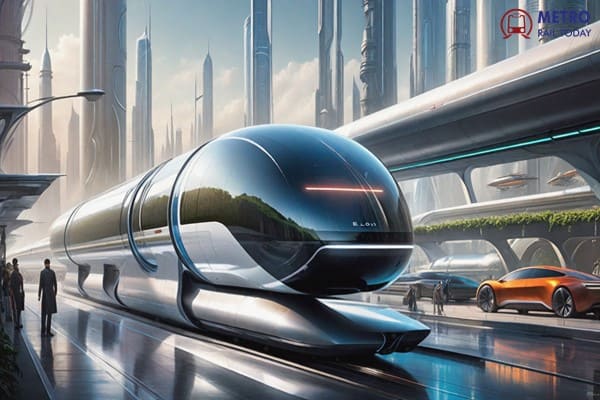
Paris, France (Metro Rail Today): France has entered a new phase of innovation in regional mobility with the public unveiling and ongoing dynamic testing of the EcoTrain, a lightweight, fully autonomous railcar designed for low-density secondary lines. Presented in late November at the Socofer plant in Tours, the EcoTrain marks a significant step toward cost-efficient, low-emission rail transport tailored for lightly used routes.
First conceptualised in 2019 by entrepreneur Philippe Bourguignon in partnership with Socofer, Stratiforme and Clearsy, the EcoTrain is engineered to meet the economic and operational needs of branch lines that struggle to justify full-scale rolling stock investments. The compact 30-seat railcar measures 12.5 m in length and 2,800 mm in width, with a four-wheel, twin-axle configuration that delivers an axleload of just 8 tonnes. Powered by lithium-ion battery packs, it offers an impressive 500 km range between charges and can reach speeds of up to 70 km/h while handling gradients of 1 in 40.
The design, while optimised for passenger transport, can also be configured to carry lightweight freight up to 2.5 tonnes, broadening its potential applications in rural logistics. A PRM-accessible space ensures basic inclusivity within the compact railcar.
Built for Captive, Driverless Operations
Unlike conventional rolling stock, the EcoTrain is not designed to meet mainline standards. Instead, it adheres to light rail regulations and is intended for isolated branch lines where infrastructure can be adapted for dedicated operation. Bourguignon describes the railcar as “user friendly, frugal and full of technology,” highlighting its readiness for GoA4 driverless functionality.
Equipped with GNSS and LiDAR-based onboard signalling systems, the EcoTrain eliminates the need for wayside signalling infrastructure, drastically reducing operational costs. Its autonomous design makes it particularly suitable for rural regions seeking to revive disused or under-utilised lines without heavy capital expenditure.
Offering an industry perspective, Mrs. Mamta Shah, MD & CEO of Urban Infra Group, said, “Innovations like the EcoTrain show how autonomy, lightweight engineering and smart digital technologies are reshaping regional mobility. These solutions can revitalise low-density rail corridors not just in France, but across the world, including emerging markets looking for cost-efficient rail revival models.”
Turnkey Deployment and Europe-Wide Potential
To further advance the concept, Bourguignon has established EcoTrain SAS, which will focus on developing turnkey solutions for specific routes. The vision includes collaborative concessions involving operators and infrastructure contractors who would refurbish track and facilities as part of a bundled service introduction model.
Proposed demonstration or deployment routes include Agen–Auch, Busseau-sur-Creuse–Felletin and Ascq–Orchies, while potential opportunities have been identified in other parts of Europe—especially Belgium. Bourguignon also notes that assembly of the EcoTrain could be carried out locally, supporting regional economic development where the railcars operate.
As dynamic testing progresses, the EcoTrain represents a promising new chapter for affordable, sustainable branch-line mobility. Its combination of lightweight engineering, autonomy and flexible deployment could become a blueprint for reviving secondary rail networks across Europe and beyond.


MRT Online Desk
Metro Rail Today is an authentic and global news provider for the Rail & Metro industry from and around the world.