


Trending Now
 Efkon India Bags ₹103 Crore Telecom Systems Contract for Mumbai Metro Lines 7A and 9
 Bids invited for Telecommunication Systems Contract for Kochi Metro Phase 2 Pink Line
 KMRL invites bids for supply of Heavy-Duty Escalators for Kochi Metro Phase 2 Pink Line
 Spain floated €357.6 Million civil works tender for Burgos–Vitoria High-Speed Rail Line
 Wabtec bags multiple contracts to supply over 680 Pantographs for Rail & Metro projects in India
 Titagarh Rail bags major Rolling Stock contract for Ahmadabad Metro Phase 2 and Surat Metro
 Indian Railways restructures Railway Board, Redeploys 50 Senior Officers to Field Duty
 T&T Infra–Univastu JV Bags ₹229.97 Crore Civil Contract of Pune Metro Rail Project
 Rail composites market set to reach $2.4 billion by 2028 as Railways embrace lightweight materials
 Alstom powers Delhi Metro's Pink and Magenta Line with Driverless Trains and CBTC Signalling
Govt of India cabinet approves ₹63,246 crore Chennai Metro Phase 2 Project
MRT Online Desk
Posted on: 2024-10-03 17:30:00
Viewer: 1,189
Comments: 0
Country: India
City: New Delhi
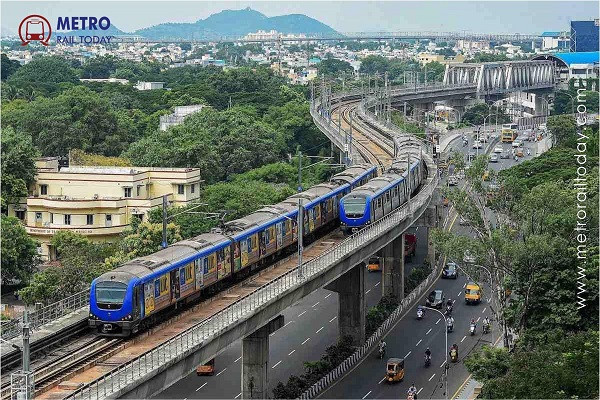
Chennai, India (Metro Rail Today): In a groundbreaking decision, the Union Cabinet, under the leadership of Prime Minister Shri Narendra Modi, has officially greenlit the Chennai Metro Rail Project Phase 2. This ambitious initiative, spearheaded by the Ministry of Housing and Urban Affairs, is set to significantly enhance the city's transport landscape by introducing three major corridors. Spanning a total length of 118.9 kilometers and comprising 128 stations, this phase aims to bolster Chennai's already burgeoning metro network, expanding it to a grand total of 173 kilometers by the time the project is fully operational in 2027.
The newly approved corridors under Chennai Metro Phase 2 are:
- Madhavaram to SIPCOT: Covering 45.8 kilometers with 50 stations.
- Light House to Poonamallee Bypass: Stretching 26.1 kilometers and including 30 stations.
- Madhavaram to Sholinganallur: Encompassing 47 kilometers with 48 stations.
This ₹63,246 crore investment not only reflects a commitment to modernizing Chennai's transport infrastructure but also addresses the pressing need for efficient public transport options in the face of the city's growing population and traffic congestion.
One of the most significant benefits of Phase 2 is the enhanced connectivity it offers. By linking North to South and East to West, these corridors traverse critical urban areas such as Madhavaram, Perambur, Thirumayilai, Adyar, Sholinganallur, and SIPCOT. This extensive coverage ensures that residents can access major industrial, commercial, residential, and institutional establishments with ease.
For instance, the corridor connecting to Sholinganallur is particularly noteworthy. This area is fast becoming a hub for the IT sector in South Chennai, and the new metro line will significantly ease transportation for the growing workforce in this region. The addition of metro services will facilitate easier commutes, thereby fostering a more productive working environment.
Traffic congestion is an ever-present challenge for Chennai, a city that has witnessed rapid urbanization. The introduction of the Chennai Metro Phase 2 is expected to provide a viable alternative to road transport. By enhancing the public transport framework, this initiative aims to alleviate congestion on heavily trafficked routes.
The anticipated outcomes include smoother vehicular movement, reduced travel times, and improved road safety. As more residents opt for the metro, the overall pressure on city roads will decrease, making commuting less of a hassle.
An often-overlooked advantage of expanding the metro system is its positive impact on the environment. With more people utilizing the metro for their daily commutes, the reliance on fossil fuel-powered vehicles is expected to diminish. This transition can lead to a significant reduction in carbon emissions, thus contributing to a healthier urban environment.
The Chennai Metro Rail Project Phase 2 represents a progressive step toward sustainable urban development, aligning with global efforts to combat climate change.
Beyond enhancing mobility and environmental sustainability, the Phase 2 project is poised to stimulate economic growth in Chennai. By reducing travel times and improving accessibility to various parts of the city, the metro system can significantly enhance productivity.
Additionally, the construction and operation phases of this project are set to generate numerous jobs across various sectors, including construction, administration, and maintenance. Local businesses near new metro stations may also see a surge in customers, which can foster investment and development in previously underdeveloped areas.
The expansion of the Chennai Metro Rail Network is not just about infrastructure; it is also about social equity. By providing equitable access to public transport, the Phase 2 project aims to benefit diverse socio-economic groups, thereby reducing transport disparities.
Improved public transport services will contribute to a higher quality of life for residents by reducing commute times and increasing access to essential services such as healthcare, education, and employment opportunities.
The Chennai Metro Rail Project Phase 2 is more than just an expansion of a transport network; it is a transformative initiative that promises to reshape the urban landscape of Chennai. With its focus on enhanced connectivity, reduced traffic congestion, environmental sustainability, and economic growth, this project stands as a crucial step toward a more efficient, equitable, and sustainable city. As Chennai continues to evolve, the successful implementation of this metro phase will be instrumental in addressing the urban challenges of today while laying the groundwork for a more connected future.

MRT Online Desk
Metro Rail Today is an authentic and global news provider for the Rail & Metro industry from and around the world.