


Trending Now
 NMRC invites Applications for Key Executive Positions for Noida Metro Rail Project
 Central Govt rejects revised DPR of 7.5 km Noida-Greater Noida Metro Rail Extension Project
 Revised DPR of Prayagraj Metro focuses on seamless Rail-Air connectivity
 DMRC floats Tender for Central Vista Depot Design in Delhi Metro Phase V Expansion
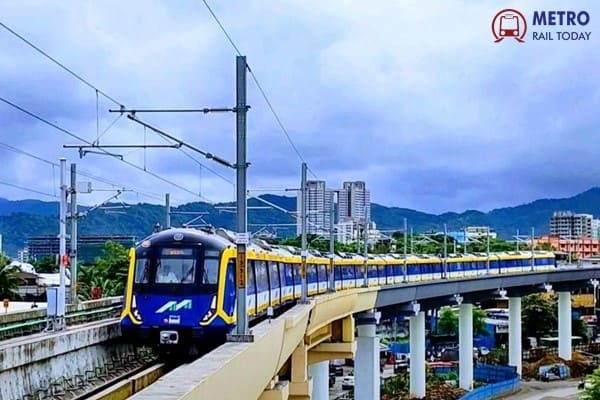 MMRDA seeks ₹14,100 Crore Loan for two upcoming Mumbai Metro Corridors
 Jupiter Wagons Eyes ₹20,000-Crore Mumbai Suburban Mega Rolling Stock Tender
 Mumbai Metro Chief Ashwini Bhide appointed as First Woman BMC Commissioner
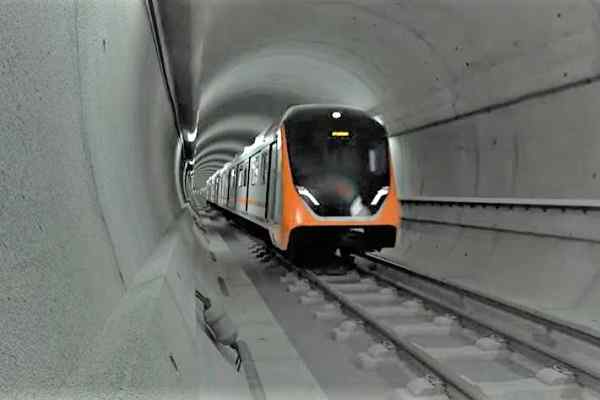 TBM ‘Parvati’ completes Underground Tunnelling on Kanpur Metro Phase 1 Project
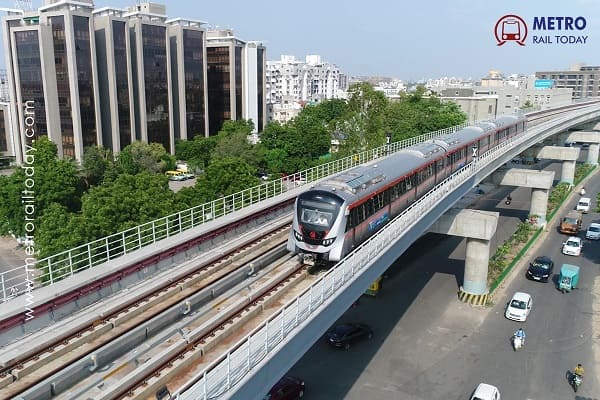 Surat Metro begins First Trial Run on 8.5 km Diamond Corridor between Dream City and Althan Tenement
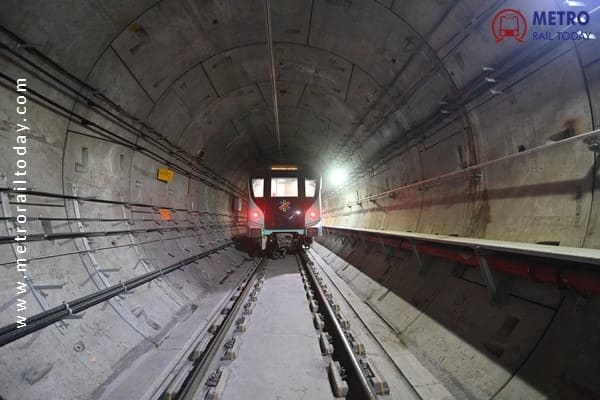 Cemindia wins ₹1,024 crore Civil Contract for Central Vista Tunnel Package of Delhi Metro Phase V
Hyderabad Metro at Crossroads: Operational Excellence, Financial Realities and the Future of PPPs
MRT Online Desk
Posted on: 2026-01-12 15:30:00
Viewer: 10,155
Comments: 0
Country: India
City: Hyderabad
India’s urban mobility story is often told through numbers—kilometres commissioned, trains inducted, ridership achieved. Yet, behind these statistics lie complex institutional choices, financial assumptions, and operational philosophies that determine whether a metro system merely runs, or truly transforms a city. The Hyderabad Metro Rail Project, the world’s largest metro developed under a Public–Private Partnership (PPP) model, stands today as one of the most instructive case studies in this regard.
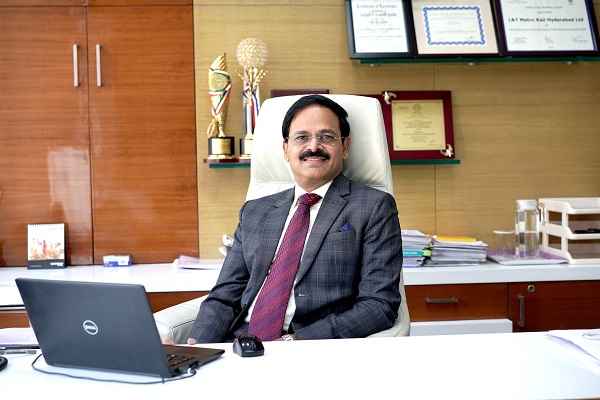
In an exclusive interaction with Metro Rail Today, Mr. K.V.B. Reddy, Managing Director & CEO of L&T Metro Rail (Hyderabad) Limited (L&TMRHL), reflected on more than four decades of professional experience and eight years at the helm of Hyderabad Metro. His insights offer a rare, ground-level view into how operational excellence can coexist with financial strain, and what this paradox means for the future of private participation in India’s metro sector.
Mr. Reddy’s professional journey mirrors the evolution of India’s infrastructure sector itself. Beginning his career in 1983 with NTPC Delhi as an Engineering Executive Trainee, he spent over a decade immersed in planning and systems operations in the power sector. This early exposure instilled a systems-oriented mindset—one that later proved critical in managing assets as complex and interdependent as a metro railway.
His move to the Essar Group in 1995 marked a transition from public-sector foundations to private-sector execution. Over the next 22 years, he led large EPC and power projects, eventually serving as CEO of Essar Power Limited. When he took charge of L&T Metro Rail Hyderabad in 2017, he brought with him a rare blend of technical depth, financial acumen, and large-scale project leadership.
For Mr. Reddy, the shift from power generation to urban mass transit was not merely a change of sector, but a change of proximity to citizens. Unlike power plants that operate largely out of public view, a metro system is judged every minute by millions of commuters. This reality, he notes, reshapes leadership priorities, placing integrity, fairness, and consistency at the core of decision-making.
Delivering Reliability Under Relentless Scrutiny
Hyderabad Metro operates in an environment of constant public and political attention. Every delay, service disruption, or fare decision is immediately visible. In such a setting, operational excellence is not optional—it is foundational to public trust.
Under L&TMRHL’s stewardship, Hyderabad Metro has emerged as India’s top-performing metro system on several key indicators. In FY24, it recorded an on-time performance of 99.99 percent, the highest among all Indian metros. Maintenance performance and car availability metrics also consistently ranked first nationally, reflecting disciplined asset management and robust engineering practices.
By 31 October 2025, the system had carried over 780 million cumulative passenger journeys. In FY24 alone, ridership reached 216.77 million, placing Hyderabad among the country’s most intensively used metro networks. These outcomes, Mr. Reddy emphasises, were not accidental. They resulted from continuous monitoring, data-driven interventions, and an organisational culture that treated punctuality and safety as non-negotiable commitments rather than aspirational targets.
The Financial Paradox of a High-Performing PPP Metro
Despite its operational success, Hyderabad Metro reached a critical inflection point with L&T’s decision to exit the project. To outside observers, this appeared counterintuitive. How could a system with industry-leading performance indicators face sustainability challenges?
The answer lies in the structural realities of metro finance under PPP frameworks. Hyderabad Metro, with a capital investment of nearly ₹20,000 crore, was built on long-term ridership and revenue projections that assumed faster modal shift from private vehicles to public transport. While ridership growth has been steady, its pace has been slower than early forecasts, extending the revenue recovery curve.
Even so, the system’s operating metrics remain exceptional. In FY24, Hyderabad Metro achieved an Operating Revenue to Operating Cost ratio of 3.22, the highest in India. Its service operations cost stood at just ₹4,861 per train-hour, again the best nationally. The cost per passenger journey was ₹20.04, ranking second among Indian metros, and the cost per passenger-kilometre was ₹2.22.
Yet, farebox revenue alone cannot sustain a capital-intensive PPP metro, particularly in a context where non-fare revenue streams remain underdeveloped. Globally, metros often derive close to 40–50 percent of their income from commercial development, advertising, and land value capture. In India, such avenues are constrained by regulatory, planning, and institutional limitations.
The COVID-19 pandemic further disrupted early-year financial assumptions, creating structural imbalances that could not be corrected through operational efficiency alone. Mr. Reddy describes L&T’s exit not as a withdrawal from responsibility, but as a measured business decision aimed at enabling a more sustainable long-term framework for the system.
Accessibility as the Backbone of Ridership Growth
A recurring theme in Hyderabad Metro’s strategy has been the recognition that a metro’s success depends as much on access as on trains and tracks. L&TMRHL invested heavily in strengthening first- and last-mile connectivity, viewing it as a core operational function rather than a peripheral service.
Feeder buses, pedestrian infrastructure, and integration with emerging e-mobility solutions were systematically expanded. Interchange flows were re-engineered to reduce transfer times and improve passenger comfort. These measures played a decisive role in sustaining ridership growth, particularly along high-density corridors serving IT hubs and commercial districts.
Sustainability was embedded into these efforts. Regenerative braking systems reduced energy consumption, stations were equipped with LED lighting, depots incorporated solar installations, and rainwater harvesting became standard practice. As a result, Hyderabad Metro consistently ranked among India’s top metros on energy efficiency indicators, ensuring that rising ridership did not translate into a proportionate increase in environmental impact.
What Hyderabad Metro Proves About the PPP Model
Hyderabad Metro remains one of the strongest demonstrations of what PPPs can deliver in urban transit when execution is disciplined. Engineering standards matched global benchmarks, service reliability exceeded national peers, and operational costs were kept among the lowest in the country.
Beyond transport metrics, the metro catalysed urban transformation. Corridors once dominated by road congestion evolved into mixed-use development zones, particularly in Hyderabad’s IT and business districts. Residential and commercial growth along the metro alignment validated the broader urban-development rationale that underpins PPP-based transit investments.
These achievements underscore a critical point: financial challenges do not negate operational success. Instead, they highlight the need for financial models that are as sophisticated and adaptive as the engineering systems they support.
Policy Gaps and the Need for Structural Reform
Mr. Reddy is clear that if India wishes to attract sustained private participation in metro projects, policy frameworks must evolve. Ridership forecasting models need to reflect actual commuter behaviour rather than optimistic modal-shift assumptions. Concession structures must be flexible enough to absorb macroeconomic shocks, including events as disruptive as a global pandemic.
Most importantly, non-fare revenue mechanisms must move from being supplementary to central components of metro finance. Land value capture, station-area commercialisation, and transit-oriented development require closer alignment between urban planning authorities and metro operators. Without this integration, even the most efficient systems will struggle to achieve long-term financial balance under PPP arrangements.
Managing Transition Without Compromising Service
During the current transition phase, L&TMRHL has worked closely with the Government of Telangana and Hyderabad Metro Rail Limited to ensure continuity of service. Comprehensive documentation, technical audits, and operations mapping are being undertaken to preserve institutional knowledge and operational integrity.
Despite the transition, Hyderabad Metro continues to maintain its benchmark performance levels, including near-perfect punctuality and high asset availability. For commuters, the change remains largely invisible—a testament to the robustness of the systems and processes established over the past decade.
Lessons for the Next Generation of PPP Metros
Hyderabad Metro’s experience offers valuable lessons for future projects. Conservative ridership assumptions, diversified revenue models, and built-in mechanisms for financial restructuring are essential. Non-fare revenue and TOD must be integral from the planning stage, not retrofitted after commissioning.
Operational excellence, while necessary, is not sufficient on its own. Financial resilience must be designed into the project architecture, acknowledging the long gestation periods inherent in urban transit investments.
The Road Ahead for Private Participation in Urban Transit
Looking forward, Mr. Reddy envisions a shift toward hybrid participation models. Even if full DBFOT structures evolve, the private sector will continue to play a critical role in EPC delivery, operations, digital systems, energy management, fare collection, and commercial development.
Technologies such as AI-driven operations, advanced demand forecasting, and integrated passenger experience platforms will require private innovation and agility. The performance benchmarks set by Hyderabad Metro demonstrate how private-sector capability can elevate public transport systems when aligned with public objectives.

MRT Online Desk
Metro Rail Today is an authentic and global news provider for the Rail & Metro industry from and around the world.