


Trending Now
 DPR submitted for 671 km Hyderabad–Pune–Mumbai High-Speed Rail Corridor
 Former Railway Board Member Anil Kumar Khandelwal Joins Advisory Board of Rail Chamber
 Govt proposes 270-km Orbital Rail Corridor to transform Regional connectivity in Delhi-NCR
 Tamil Nadu approves ₹9,335 Crore Chennai Airport–Kilambakkam Metro Corridor
 NCRTC to appoint General Consultant for Delhi–Panipat–Karnal Namo Bharat RRTS Corridor
- The Role of Train Systems in Sustainable Public Transportation
 Govt of India approves ₹20,667 crore Ahmedabad - Dholera Semi High Speed Rail Corridor
 ICF signs ₹1,513 crore contract to supply Rolling Stock to Bengaluru Suburban Rail Project
 Siemens wins ₹91.65 crore Telecom Contract for Kochi Metro Phase 2 Pink Line
 GHV Infra wins ₹150 crore Civil Contract for Vasantkunj Depot of Lucknow Metro East-West Corridor
Maharashtra Govt approves 35-km Mumbai-Navi Mumbai Gold Line Metro Project
MRT Online Desk
Posted on: 2026-01-27 10:15:00
Viewer: 2,643
Comments: 0
Country: India
City: Mumbai
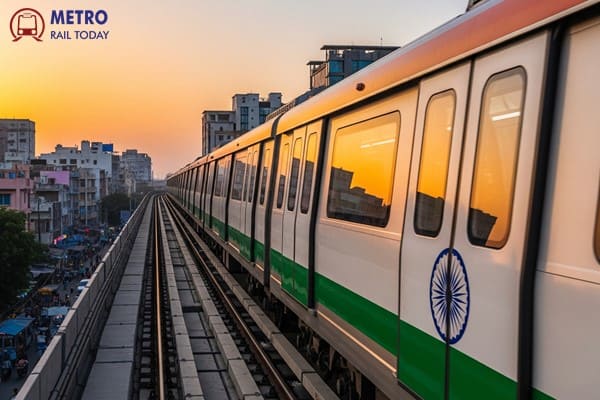
Mumbai, India (Metro Rail Today): In a landmark decision set to redefine urban mobility in the Mumbai Metropolitan Region, the Maharashtra Cabinet has approved Metro Line 8, popularly known as the Gold Line, a high-speed metro corridor that will directly connect Chhatrapati Shivaji Maharaj International Airport in Mumbai with the upcoming Navi Mumbai International Airport. The long-awaited approval marks a crucial milestone towards seamless, rail-based airport-to-airport connectivity in India’s financial capital.
Once operational, the Gold Line is expected to cut travel time between the two major aviation hubs to just 30–35 minutes, a dramatic improvement over existing road journeys that often exceed 90 minutes due to heavy congestion. The project is being viewed as a critical backbone for Mumbai’s emerging twin-airport system, designed to handle surging passenger demand in the coming decades.
Route Alignment and Project Design
Metro Line 8 will span approximately 35 km, combining underground and elevated sections to navigate the dense urban fabric of Mumbai and the rapidly developing Navi Mumbai region. The corridor will originate at CSMIA Terminal 2 and terminate at Navi Mumbai International Airport, ensuring direct terminal-level connectivity at both ends.
The underground section, stretching roughly 9 km, will run from the Mumbai airport area up to Ghatkopar East, after which the line will continue on elevated viaducts towards Navi Mumbai. Around 20 stations are planned along the route, enabling integration with existing and upcoming metro corridors and allowing the line to serve not only airport passengers but also daily commuters.
Commenting on the significance of the project, Mrs. Mamta Shah, MD & CEO of Urban Infra Group, said, “Metro Line 8 is a visionary step that reflects Maharashtra’s commitment to future-ready urban infrastructure. Direct airport-to-airport metro connectivity will not only transform passenger experience but also strengthen Mumbai’s position as a global aviation and business hub.”
Economic Impact and Strategic Importance
The state government has set an ambitious implementation roadmap, directing authorities to complete land acquisition and statutory clearances within six months, with construction targeted for completion within three years of approval. The project is expected to generate significant employment during construction and catalyse real estate, commercial and transit-oriented development along the corridor.
Dr. Vinod Shah, Director General of the Indian Chamber of Railway Industries (Rail Chamber), highlighted the broader impact, stating, “The Gold Line represents the next evolution of metro-led growth in India. By linking two international airports through a dedicated rapid transit system, Mumbai is setting a benchmark for integrated, sustainable and high-capacity urban transport.”
As Navi Mumbai International Airport prepares for phased operations, Metro Line 8 is poised to play a pivotal role in balancing passenger traffic between the two airports. With congestion-free, reliable connectivity, the Gold Line is expected to emerge as one of the most transformative transport projects in the Mumbai Metropolitan Region, reinforcing the city’s push towards efficient, inclusive and future-focused mobility.


MRT Online Desk
Metro Rail Today is an authentic and global news provider for the Rail & Metro industry from and around the world.