

Trending Now
 RITES submits fresh DPR to UPMRC for ₹12,000 crore Prayagraj Metro Rail Project
 Paras Railtech wins ₹84.72 crore Ballastless Track Contract for Jaipur Metro Rail Project
 Indian Railways announces 3,548 Graduate-Level Vacancies under NTPC Recruitment 2026
 European Union sanctions €10 million to support extension of Hanoi Metro Line 3
 GMRC issues ₹683 crore Tender for construction of 8.68 km stretch for Ahmedabad Metro
- GMRC launches ₹439 crore Tender for construction of 5 New Ahmedabad Metro Stations
 Global tender issued for procurement of 60 Rolling Stock coaches for Hyderabad Metro Rail Project
 Global tender issued for procurement of 102 Rolling Stock coaches for Patna Metro Rail Project
 Gamuda awarded RM3.7 billion contract to build Keelung Mass Rapid Transit in Taiwan
 Maharashtra forms special Task Force to plan Rail, Metro and RRTS expansion
India to Roll Out First Hydrogen-Powered Train Trials on January 26
MRT Online Desk
Posted on: 2026-01-05 14:05:00
Viewer: 2,520
Comments: 0
Country: India
City: New Delhi
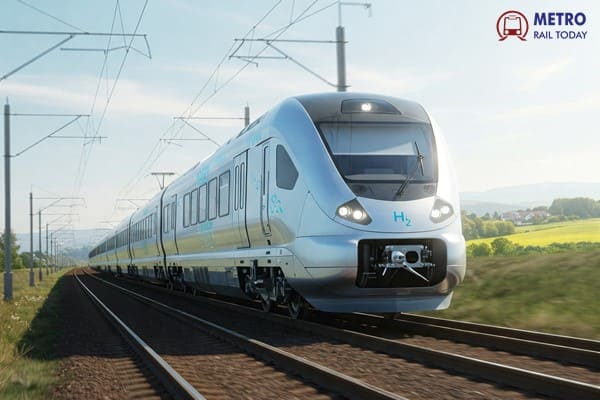
New Delhi, India (Metro Rail Today): India is poised to enter 2026 with a landmark breakthrough in green transportation, as the country’s first hydrogen-powered train gears up for trial operations later this month. Prime Minister Narendra Modi is expected to inaugurate the historic trial run on Republic Day, January 26, 2026, on the 90-km Jind–Sonipat section in Haryana.
The initiative marks a significant step toward reducing Indian Railways’ dependence on diesel traction and cutting down greenhouse gas emissions from the rail sector.
Trials Ready to Begin
Indian Railways, in partnership with the Research Designs and Standards Organisation (RDSO) and Spanish technology firm Green H, has completed preparations for the maiden trial.
-
Two driver power cars
-
Eight passenger coaches
-
Designed speed: up to 150 kmph
-
Initial operational speed: 110–140 kmph
-
Likely travel time: 1 hour (vs 2 hours currently by DMU)
After the trial run, a joint performance report will be submitted to the Centre, which will decide on commercial deployment and scaling of hydrogen-powered services across the network.
Clean Technology at the Core
The train uses electrochemical hydrogen fuel-cell technology, producing electricity through a reaction between hydrogen and oxygen.
Key technical highlights include:
-
About 900 grams of hydrogen per km consumption
-
Hydrogen generated from nine kilograms of water
-
Storage capacity: 3,000 kg hydrogen and 7,680 kg oxygen
-
Power generation via fuel cells: 3,750-ampere DC current
-
Dual 1,200-HP driver cars
-
Onboard systems powered: lighting, HVAC, and controls
The fuel produced emits only steam and water vapor, eliminating particulate and carbon emissions associated with diesel locomotives.
India’s Largest Hydrogen Plant in Jind
Supporting the project is India’s largest hydrogen production plant being built at Jind railway junction:
-
Cost: ₹120 crore
-
Area: 2,000 sq. metres
-
Underground hydrogen storage tanks
-
1.5 MW power supply
-
Water requirement: up to 40,000 litres per hour
-
Extensive rainwater harvesting system planned
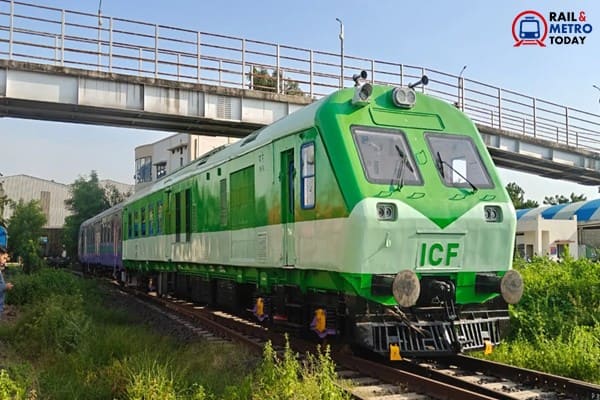
Coaches for the hydrogen-powered rake were manufactured at the Integral Coach Factory (ICF), Chennai, and later transferred to Shakurbasti for phased induction.
Passenger Amenities and Capacity
The hydrogen train will feature:
-
Automatic doors
-
Digital passenger information systems
-
Air-conditioned interiors
-
Seating and standing capacity for around 2,500 passengers
Ticket fares on the Jind–Sonipat section are expected to range between ₹5 and ₹25.
The trainset has reportedly been developed at an estimated cost of ₹89 crore.
Efficiency & Environmental Gains
Officials estimate:
-
Fuel efficiency equal to 4.5 litres of diesel per kg of hydrogen
-
Lower lifecycle maintenance compared to diesel locomotives
-
Longer operating range than electric trains without overhead wires
The electricity produced by fuel cells will also charge lithium-ion batteries, with provisions for renewable energy storage using super-capacitors.
Haryana Assembly Deputy Speaker and Jind MLA Dr. Krishan Middha hailed the project, stating it is a matter of great pride for the state and the nation. He added that establishing the country’s largest hydrogen plant will place Jind “on the global map of green mobility innovation.”
The Jind–Sonipat hydrogen train project is expected to be extended further after initial trials and is being seen as a foundation stone for India’s hydrogen rail ecosystem.
Commenting on the development, Mrs. Mamta Shah, MD & CEO, Urban Infra Group, said:
“Hydrogen-powered trains represent a transformational leap toward achieving India’s carbon-neutral mobility goals. This initiative not only reduces dependence on imported fossil fuels but also positions Indian Railways as a global frontrunner in sustainable transportation innovation.”
With this milestone, India joins a select group of nations experimenting with hydrogen traction in railway systems, following pioneering deployments in Europe and Japan.

MRT Online Desk
Metro Rail Today is an authentic and global news provider for the Rail & Metro industry from and around the world.