

Trending Now
 Spain investigates CAF’s role in Jerusalem Light Rail Project amid Human Rights allegations
 Dr. Amit Kumar Jain conferred Delhi CM’s Award 2026 for driving Digital Innovation in Urban Mobility
 UAE Approves AED 34 Billion First Fully Underground Dubai Metro Gold Line Project
 Power Mech Projects bags ₹296 crore O&M Contract for Mumbai Monorail Project
 Spain’s Hyperloop Startup Zeleros files for Insolvency amid funding crunch
 Siemens Mobility bags €325 Million Hydrogen Train Contract from Romania
 MMRDA issues PMC tender for Mumbai Water Metro Phase 1 Project
 IRFC 2.0: Financing India’s Rail Revolution with a New-Age Infrastructure Funding Model
 Railway Ministry orders ICF to build Two High-Speed, Broad-Gauge Trains for 2027–28
 Rail Chamber appoints Global EPC Leader Rakesh Gaur as Independent Advisor
India to run Shinkansen E10 Bullet Trains on Mumbai-Ahmedabad High Speed Rail Corridor
MRT Online Desk
Posted on: 2025-07-14 07:50:00
Viewer: 4,765
Comments: 0
Country: India
City: New Delhi

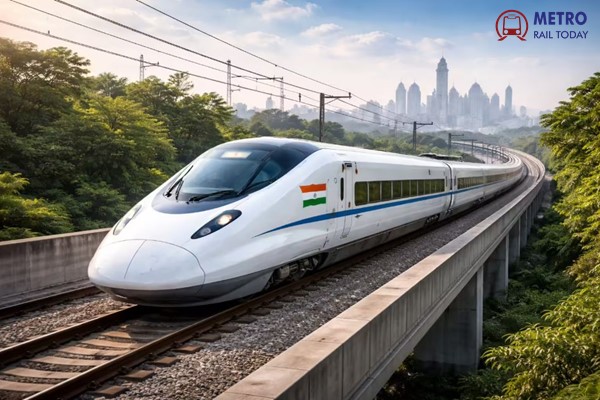
New Delhi, India (Metro Rail Today): The Ministry of Railways on Monday confirmed that Japan’s next-generation Shinkansen E10 (Alfa-X) trains will be deployed on the Mumbai-Ahmedabad High-Speed Rail (MAHSR) corridor — putting an end to recent speculation regarding the possible use of indigenously-built alternatives.
In an official statement, the ministry highlighted that E10 trains — still under development — will be introduced simultaneously in both India and Japan. This move reflects the “strategic partnership” between the two nations, strengthening the bilateral cooperation in high-speed rail technology.
“The Japanese government has agreed to introduce E10 Shinkansen trains in the Mumbai-Ahmedabad bullet train project. This reinforces India’s commitment to deploying cutting-edge rail technology in collaboration with global leaders,” the ministry stated.
What Makes the E10 Shinkansen Special?
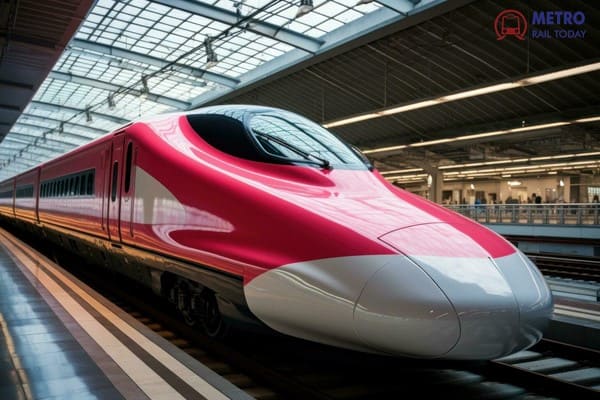
The E10 model, also known as Alfa-X, is the most advanced version of Japan’s famed bullet trains. It will be capable of reaching speeds up to 400 kmph, making it 25% faster than the currently operational E5 trains.
Until this announcement, there was ongoing debate over the cost-effectiveness of importing Japanese Shinkansen trains versus deploying locally manufactured high-speed trainsets. In 2023, BEML was awarded a contract by the Integral Coach Factory (ICF) to develop two high-speed prototypes with top speeds of 280 kmph. The estimated cost for the two prototypes is ₹866.87 crore, with each coach priced at ₹27.86 crore.
MAHSR: Japan’s High-Speed Tech in India
The entire 508-km Mumbai-Ahmedabad High Speed Rail corridor is being built using Japanese Shinkansen technology. It includes India’s first undersea rail tunnel, a 21-km section between BKC (Mumbai) and Shilphata (Thane) — where the first breakthrough has recently been achieved.
The Japan International Cooperation Agency (JICA) is financing 81% of the total cost through an official development assistance loan at a 0.1% interest rate. The remainder is being shared by the Central Government and the state governments of Maharashtra and Gujarat.
Laying the Groundwork for Future Bullet Train Corridors
The ministry emphasised that the success of the MAHSR project is pivotal for shaping India’s high-speed rail ambitions, with future corridors currently under active consideration.
“The Mumbai-Ahmedabad bullet train is not just a transport project; it is a technological leap forward that sets the stage for next-generation infrastructure in India,” the statement added.
The confirmation of E10 Shinkansen trains for the Mumbai-Ahmedabad High Speed Rail corridor underlines India's intent to integrate global best-in-class high-speed rail solutions, while balancing domestic innovation through prototype development. As the country moves closer to launching its first bullet train service, expectations are high for both speed and scale in future intercity mobility.

MRT Online Desk
Metro Rail Today is an authentic and global news provider for the Rail & Metro industry from and around the world.