

Trending Now
 NHSRCL invites bids to standardise Civil Designs for India’s Future Bullet Train Corridors
 CMRL invites bids for preparation of DPRs for two new Chennai Metro Extension Corridors
 JICA debt on Delhi Metro Rail Corporation remains above ₹35,000 crore as of June 2026
 Jupiter Wagons partners with Lucchini RS and SIMEST to build India’s First Private Railwheel Plant
 Indian Railways plans ₹1 Lakh crore East-West Dedicated Freight Corridor under PPP Model
 Delhi-Gurugram-Bawal Namo Bharat RRTS Corridor set for Behror Extension after PIB clearance
 Thiruvananthapuram, Kozhikode Metro projects face uncertainty as Centre tightens population norm
- Indian Railways Plans Standard Design for Seven New High-Speed Bullet Train Corridors
 India’s First Vande Bharat Freight EMU hits 145 kmph in Technical Trials in Rajasthan
 Centre rejects Coimbatore and Madurai Metro proposals again, Suggests BRTS as an alternative mode
NHSRCL invites bids to standardise Civil Designs for India’s Future Bullet Train Corridors
MRT Online Desk
Posted on: 2026-08-03 08:49:00
Viewer: 79
Comments: 0
Country: India
City: New Delhi
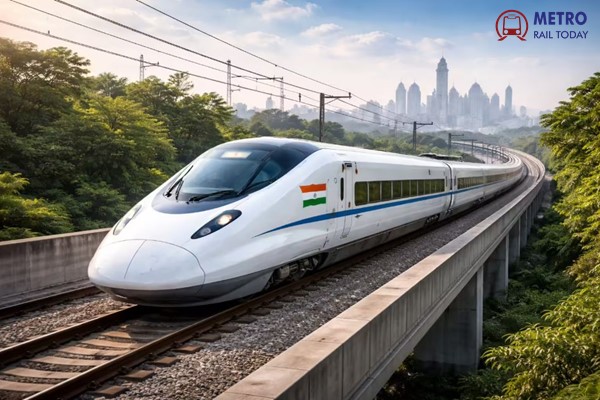
New Delhi, India (Rail & Metro Today): The National High Speed Rail Corporation Limited (NHSRCL) has invited bids for a consultancy to develop standardised civil structure designs for future high-speed rail corridors under the Bharat High Speed Rail Programme, marking an important shift towards a common engineering framework for India's expanding bullet train network.
The initiative is aimed at moving beyond corridor-specific engineering and developing reusable design solutions that can accelerate project preparation, improve construction efficiency and create greater uniformity across India's future high-speed rail projects.
Chennai–Bengaluru and Delhi–Varanasi Corridors to Lead Initiative
The consultancy will initially focus on two proposed high-speed rail corridors — Chennai–Bengaluru and Delhi–Varanasi.
The scope covers the development of standard engineering designs for major civil infrastructure, including underground stations, tunnels, viaducts and associated structures required for high-speed rail operations.
Among the key structures covered under the exercise are proposed underground stations in Chennai, Bengaluru and Jewar, along with a 9-km tunnel on the Delhi–Varanasi corridor.
The standardised designs are expected to provide a common technical reference for future detailed engineering and construction activities.
Design Library to Accelerate High-Speed Rail Development
The development of reusable engineering templates is expected to help NHSRCL reduce the time required for designing major civil structures while improving consistency between different high-speed rail projects.
Standardisation could also simplify engineering approvals, procurement and construction planning. Repeated use of proven design solutions may reduce design-related complexity and enable contractors and suppliers to become familiar with common technical requirements.
The approach is particularly significant as India moves from developing its first bullet train corridor towards a larger national high-speed rail network.
Lessons from Mumbai–Ahmedabad Bullet Train Project
The initiative builds on the experience gained during the implementation of the 508-km Mumbai–Ahmedabad High-Speed Rail (MAHSR) corridor, India's first bullet train project.
The MAHSR project is being developed with advanced high-speed rail technologies and is scheduled to be opened in phases, with sections targeted for commissioning between 2027 and 2029.
The engineering experience, construction methodologies and technical lessons emerging from MAHSR are expected to provide valuable inputs for developing the standards and design solutions for subsequent corridors.
Building a Common Engineering Framework
NHSRCL's latest consultancy represents a broader effort to establish an indigenous and standardised engineering knowledge base for India's high-speed rail programme.
Instead of developing every major structure from scratch for individual corridors, a common design framework can enable the adaptation of established solutions to different geographical and geological conditions.
This could be particularly useful for structures such as viaducts, tunnels and underground stations, where design standardisation can help reduce engineering duplication while maintaining the necessary flexibility for site-specific requirements.
Supporting India's Expanding Bullet Train Network
India has announced multiple new high-speed rail corridors as part of its long-term rail modernisation strategy. As the number and scale of proposed projects increase, efficient project preparation will become increasingly important.
The standardisation exercise could help create a more scalable model for high-speed rail development by combining common engineering standards with corridor-specific adaptations.
Internationally, countries with extensive high-speed rail networks have increasingly relied on standardised designs and modular engineering approaches to improve project delivery, reduce costs and simplify maintenance.
For India, the creation of a standardised civil design framework could similarly help establish a consistent technical foundation for future bullet train projects.
As the country prepares to expand high-speed rail beyond the Mumbai–Ahmedabad corridor, the NHSRCL initiative could become an important building block in developing a faster, more efficient and standardised national high-speed rail network.


MRT Online Desk
Metro Rail Today is an authentic and global news provider for the Rail & Metro industry from and around the world.