


Trending Now
 The Role of Train Systems in Sustainable Public Transportation
 Govt of India approves ₹20,667 crore Ahmedabad - Dholera Semi High Speed Rail Corridor
 ICF signs ₹1,513 crore contract to supply Rolling Stock to Bengaluru Suburban Rail Project
 Siemens wins ₹91.65 crore Telecom Contract for Kochi Metro Phase 2 Pink Line
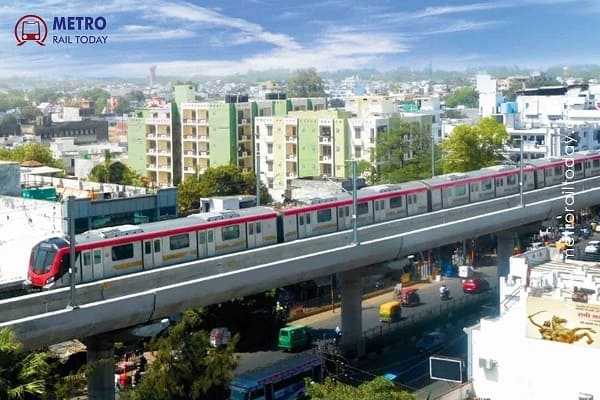 GHV Infra wins ₹150 crore Civil Contract for Vasantkunj Depot of Lucknow Metro East-West Corridor
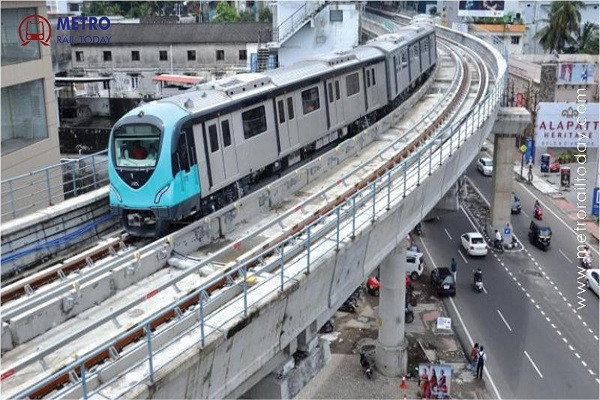 Texmaco Rail wins ₹130 crore Track Contract for Kochi Metro Phase 2 Pink Line
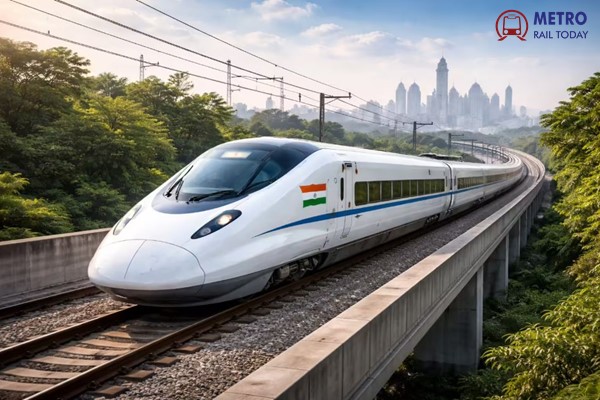 Indian Railways unveils Alignments and Routes of four new High Speed Bullet Train Corridors
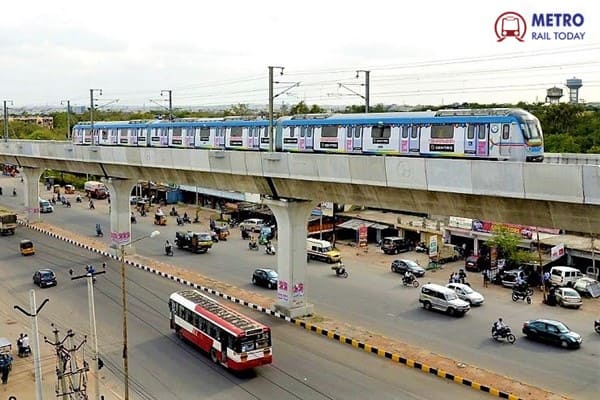 Telangana pushes for approval of ₹38,595 Crore Hyderabad Metro Phase-II Expansion
 Boston Consulting Group appointed to prepare 10 years Corporate Plan for Delhi Metro
 Exclusive Interview with Champak Panda, Managing Director, Rolling Stock & Components, Alstom India
The ₹1.98 Lakh Crore Masterclass: Why India’s High-Speed Rail is a Price Worth Paying
Dr. Vinod Shah
Posted on: 2026-01-03 12:27:00
Viewer: 23,758
Comments: 0
Country: India
City: New Delhi
The Mumbai-Ahmedabad High-Speed Rail (MAHSR) corridor is no longer just an ambitious infrastructure project; it has become a crucible for India’s engineering future. While recent headlines have focused on the 83% cost escalation—pushing the budget from ₹1.1 lakh crore to ₹1.98 lakh crore—a deeper analysis reveals that this investment is buying much more than a fast commute. It is a down payment on a new industrial ecosystem.
The Reality of the "Delay Tax"
Infrastructure at this scale does not exist in a vacuum. The four-year delay, primarily driven by protracted land acquisition in Maharashtra and statutory clearances, has triggered a "triple threat" of fiscal pressures:
-
Inflationary Compounding: The surge in global prices for steel, cement, and specialized labor since 2020.
-
Currency Volatility: Fluctuations in the Yen-Rupee exchange rate impacting JICA-funded procurement.
-
The Complexity Premium: The finalization of rolling stock (the E5 Series Shinkansen) and the technical demands of the Palghar undersea section.
However, perspective is vital. When compared to global peers, India’s $47 million per kilometer cost remains significantly more efficient than the UK’s HS2 ($377M/km) or California’s HSR ($160M/km).
Progress Report: The Tipping Point
As of the latest briefings from NHSRCL and the Railway Board, the project has moved past its most volatile phase.
| Metric | Status (as of late 2025) |
| Physical Progress | 55.6% |
| Financial Progress | 69.6% |
| Surat-Bilimora Milestone | August 2027 |
| Full Corridor Target | December 2029 |
With ₹85,801 crore already spent, the project is entering the "systems integration" phase. The gap between financial and physical progress indicates that high-value procurement and heavy civil engineering are largely front-loaded, setting the stage for rapid visible progress in the coming 24 months.
More Than Tracks: A National Laboratory
The true ROI of the MAHSR lies in the Transfer of Technology (ToT). India is currently undergoing a national masterclass in high-precision engineering:
-
FSLM (Full Span Launching Method): Casting and placing 1,100-tonne girders is redefining Indian bridge-building.
-
J-Slab Track System: Moving away from traditional ballast to high-stability concrete slabs designed for 320 km/h.
-
Undersea Mastery: The 7km tunnel under Thane Creek is providing the blueprint for future sub-aqueous transit in India.
This isn't just "buying" a train; it is "learning" to build a system. The engineers being trained at the Vadodara HSR Institute are the vanguard who will eventually execute the "Diamond Quadrant" connecting Delhi, Kolkata, and Chennai.
Global High-Speed Rail Cost Comparison (2026 Update)
While the ₹1.98 lakh crore ($23.8 Billion) price tag is significant, the cost per kilometer remains competitive when compared to Western counterparts, though it has moved closer to the "complexity premium" seen in dense, developing economies like Indonesia.
| Project | Length | Original Budget (Estd.) | Current/Final Budget | Cost Escalation | Cost per KM (Approx.) |
| India: MAHSR | 508 km | ~$13.2 Billion | ~$23.8 Billion | 83% | $47 Million |
| UK: HS2 (Phase 1) | 225 km | ~$27.0 Billion | ~$85.0 Billion | ~210% | $377 Million |
| USA: California HSR | 800 km | ~$33.0 Billion | ~$128.0 Billion | ~288% | $160 Million |
| Indonesia: Whoosh | 142 km | ~$5.5 Billion | ~$7.9 Billion | ~43% | $55 Million |
The Economic Multiplier: Birth of a Mega-Region
The most profound impact of the MAHSR will be the economic compression of South Gujarat and Maharashtra. By turning a 7-hour journey into a 2-hour dash, the project merges these distinct economies into a single "Mega-Region."
-
Bilimora & Vapi: Poised to become residential and agro-processing hubs, offering high-quality living just 15–20 minutes from the commercial centers of Surat.
-
Bharuch: Facilitating "just-in-time" executive movement to the Dahej chemical belt, allowing multinational HQs to remain in Mumbai while operations thrive in Gujarat.
-
Transit-Oriented Development (TOD): The 12 stations are being designed as "city centers," attracting malls, offices, and high-density housing that will catalyze local GDP growth by an estimated 0.5% to 1% annually.
Expert Insight: Is the ROI Still There?
Critics will point to the ₹1.98 lakh crore figure as a reason for caution regarding future corridors. However, an expert lens suggests a different perspective: The MAHSR is an investment in a new industrial ecosystem.
-
Technology Transfer: India is not just buying a train; it is learning to build high-speed viaducts and seismic-resistant pillars that will be standard for the next century.
-
Economic Agglomeration: By connecting the financial hub of Mumbai with the industrial powerhouse of Ahmedabad, the project aims to create a "mega-region" that could contribute disproportionately to the national GDP.
The ₹1.98 lakh crore figure is a significant pill to swallow, but in the world of high-speed rail, the first line is always the most expensive. It is the "tuition fee" for domestic capability.
As the Prime Minister's Office directs an expedited completion, the focus shifts from if the project will succeed to how it will transform India. By December 2029, the MAHSR won't just be a way to get from Mumbai to Ahmedabad; it will be the backbone of a modernized, high-velocity Indian economy.


Dr. Vinod Shah
Dr. Vinod Shah is an experienced urban transport journalist, blogger and key opinion leader.