


Trending Now
 Paras Railtech wins ₹84.72 crore Ballastless Track Contract for Jaipur Metro Rail Project
 Indian Railways announces 3,548 Graduate-Level Vacancies under NTPC Recruitment 2026
 European Union sanctions €10 million to support extension of Hanoi Metro Line 3
 GMRC issues ₹683 crore Tender for construction of 8.68 km stretch for Ahmedabad Metro
- GMRC launches ₹439 crore Tender for construction of 5 New Ahmedabad Metro Stations
 Global tender issued for procurement of 60 Rolling Stock coaches for Hyderabad Metro Rail Project
 Global tender issued for procurement of 102 Rolling Stock coaches for Patna Metro Rail Project
 Gamuda awarded RM3.7 billion contract to build Keelung Mass Rapid Transit in Taiwan
 Maharashtra forms special Task Force to plan Rail, Metro and RRTS expansion
 Govt. of India approves ₹12,200 crore, 29-km Thane Integral Ring Metro project in Maharashtra
Vietnam needs over 70,000 Engineers and Skilled Workers for Ho Chi Minh City Metro Project
MRT Online Desk
Posted on: 2026-09-15 15:10:00
Viewer: 3,397
Comments: 0
Country: Vietnam
City:
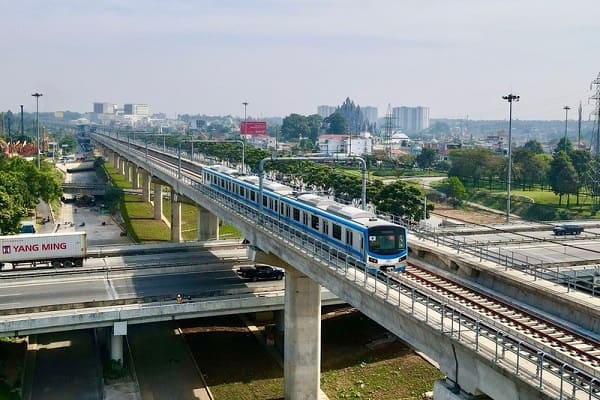
Ho Chi Minh City, Vietnam (Rail & Metro Today): Ho Chi Minh City is preparing for a major expansion of its urban railway network, but the city faces a significant shortage of skilled professionals needed to design, build, operate and maintain the planned metro system. Authorities estimate that around 70,000 workers will be required by 2030 to support the development of the city's rapidly expanding urban rail network.
The demand covers a wide range of specialised occupations, including project management, engineering, design, construction, railway operations, maintenance, consultancy and technical services. The scale of the requirement is expected to increase further as Ho Chi Minh City moves towards its longer-term ambition of developing hundreds of kilometres of metro lines.
Ambitious Metro Expansion Plans
Under its urban railway development programme, Ho Chi Minh City aims to complete six metro lines with a combined length of around 187 kilometres over the next five years. By 2035, the city plans to have 14 urban railway lines covering approximately 462 kilometres in operation.
Metro Line No. 2, connecting Ben Thanh and Tham Luong, is scheduled to be completed and enter service in 2030. Other priority projects include extensions of Metro Line No. 1, the Thu Dau Mot–Ho Chi Minh City section of Metro Line No. 2, Metro Line No. 3 connecting Vung Tau, Ba Ria and Phu My, and Metro Line No. 6, planned as an inner ring route.
Together, these priority projects represent around 180 kilometres of additional urban railway development, creating substantial demand for skilled personnel throughout the project lifecycle.
The experience of Metro Line No. 1 has already demonstrated the scale of human resources required to operate a modern metro system. According to Le Minh Triet, Director of Ho Chi Minh City Urban Railway Company No. 1 (HURC1), operating the city's first metro line requires hundreds of specialised workers, with the overall requirement reaching close to 1,000 personnel across different functions.
HURC1 currently employs around 700 people to operate Metro Line No. 1, supporting nearly 200 train trips every day. Its workforce includes station operations and management teams, train drivers, train controllers and maintenance specialists.
70,000 Workers Needed by 2030
Under the human resources training programme approved by the Ho Chi Minh City People's Committee, the city expects to need approximately 70,000 workers by 2030 for its urban railway development programme.
Around 30,000 workers are expected to be required for operations, maintenance and technical positions, while approximately 12,000 workers will be needed for construction-related activities. The remaining workforce will include project managers, engineers, consultants, designers and other specialists supporting the development of the metro network.
The city's longer-term workforce planning is even more ambitious. Its training strategy for the 2030–2045 period envisages substantially higher personnel requirements as Ho Chi Minh City works towards a metro network that could eventually extend to around 700 kilometres.
“The development of a large urban railway network requires much more than investment in tracks, stations and rolling stock. A sustainable metro system also depends on a strong ecosystem of engineers, technicians, operators, maintenance specialists and technology professionals. Ho Chi Minh City's experience highlights the importance of developing human resources alongside infrastructure so that new metro systems can be operated safely, efficiently and independently over their entire lifecycle,” said Mrs. Mamta Shah, MD & CEO, Urban Infra Group.
Focus on Railway Technology and Training
The growing workforce requirement is encouraging universities and research institutions in Vietnam to strengthen specialised railway education. Particular attention is being given to engineering disciplines linked to smart transportation and advanced urban railway systems.
The objective is to develop engineers and technical professionals capable of managing increasingly complex infrastructure projects while reducing dependence on overseas expertise.
Nguyen Quoc Trung, Deputy General Director of Dai Quang Minh Real Estate Investment JSC under THACO, which is the general contractor for a Metro Line No. 2 package, has stressed the importance of training and standardising the domestic workforce.
According to Trung, Vietnam needs to develop its own capabilities in urban railway technology, construction and engineering rather than remaining dependent on foreign contractors for key technological and construction solutions. THACO is consequently preparing to strengthen its capabilities as part of the wider development of Vietnam's domestic railway industry.
Technology Transfer for Metro Line No. 2
Technology transfer is also emerging as an important component of Ho Chi Minh City's strategy.
The city's Management Authority for Urban Railways (MAUR) and Global Technology-Telecommunications Corporation (GTEL) have signed a memorandum of understanding covering cooperation in system integration research and technology transfer for the urban railway network.
The initial focus will be on Metro Line No. 2 and other urban railway projects planned for 2026–2030. The cooperation is expected to support the gradual acquisition and development of domestic expertise in critical railway subsystems.
These include telecommunications, signalling, power supply, electrical and mechanical systems, supervisory control and data acquisition (SCADA), the operations control centre (OCC), automatic fare collection (AFC) and platform screen doors (PSD).
The combination of large-scale infrastructure investment, specialist training and technology transfer could become an important part of Ho Chi Minh City's strategy to build a more self-reliant urban railway ecosystem. As the city moves from operating a single metro line towards a much larger interconnected network, developing the workforce capable of delivering and managing that system will be as important as constructing the physical infrastructure itself.

MRT Online Desk
Metro Rail Today is an authentic and global news provider for the Rail & Metro industry from and around the world.
