

Trending Now
 Paras Railtech wins ₹84.72 crore Ballastless Track Contract for Jaipur Metro Rail Project
 Indian Railways announces 3,548 Graduate-Level Vacancies under NTPC Recruitment 2026
 European Union sanctions €10 million to support extension of Hanoi Metro Line 3
 GMRC issues ₹683 crore Tender for construction of 8.68 km stretch for Ahmedabad Metro
- GMRC launches ₹439 crore Tender for construction of 5 New Ahmedabad Metro Stations
 Global tender issued for procurement of 60 Rolling Stock coaches for Hyderabad Metro Rail Project
 Global tender issued for procurement of 102 Rolling Stock coaches for Patna Metro Rail Project
 Gamuda awarded RM3.7 billion contract to build Keelung Mass Rapid Transit in Taiwan
 Maharashtra forms special Task Force to plan Rail, Metro and RRTS expansion
 Govt. of India approves ₹12,200 crore, 29-km Thane Integral Ring Metro project in Maharashtra
Govt of India approves DPR of 671-km Hyderabad-Mumbai High Speed Bullet Train Project
MRT Online Desk
Posted on: 2026-09-02 13:19:00
Viewer: 2,017
Comments: 0
Country: India
City: New Delhi
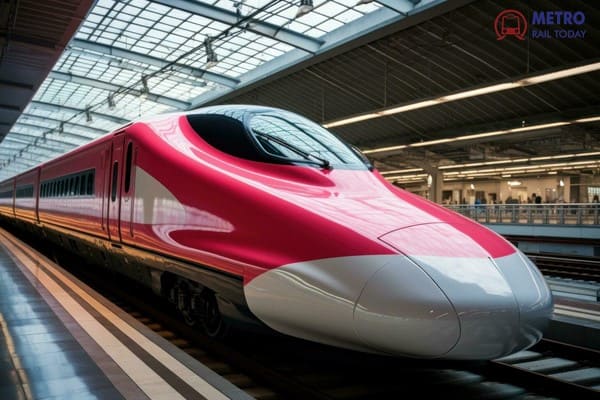
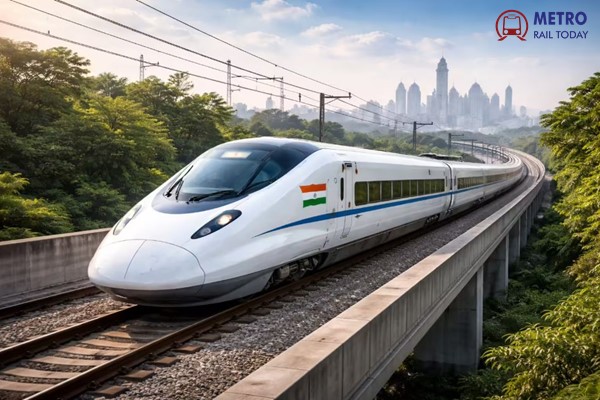
New Delhi, India (Rail & Metro Today): Hyderabad is moving closer to becoming a major hub on a proposed 671-km Mumbai–Pune–Hyderabad High-Speed Rail corridor, following the completion and approval of the project’s Detailed Project Report (DPR). The proposed bullet train corridor would connect major economic centres across Maharashtra, Karnataka and Telangana, significantly reducing travel time between Mumbai and Hyderabad.
The project is now expected to move towards the next stages of detailed planning and land-related preparations. The proposed corridor is estimated to involve an investment of between ₹1.5 lakh crore and ₹2 lakh crore.
If implemented as proposed, the high-speed rail corridor could emerge as one of India's major future intercity transport networks, linking Mumbai with Navi Mumbai, Lonavala, Pimpri-Chinchwad, Pune, Baramati, Pandharpur, Solapur, Kalaburagi, Vikarabad and Hyderabad.
671-km Corridor to Link Three States
The proposed Mumbai–Hyderabad bullet train project will pass through Maharashtra, Karnataka and Telangana, creating a new high-speed rail connection between key commercial, industrial and technology centres.
For Hyderabad, the corridor could strengthen economic integration with Mumbai and Pune, two of India's most important financial, industrial and technology markets. Hyderabad itself is a major centre for technology, pharmaceuticals, manufacturing and services.
The proposed high-speed trains are expected to operate at speeds of up to 300 kmph, potentially reducing the existing conventional rail journey between Mumbai and Hyderabad from approximately 12 to 15 hours to around three to three-and-a-half hours.
The proposed Mumbai–Pune journey could take about 48 minutes, providing a major alternative for intercity travel within Maharashtra.
Mrs. Mamta Shah, MD & CEO, Urban Infra Group, said, “The proposed Mumbai–Pune–Hyderabad high-speed rail corridor has the potential to transform connectivity between some of India's most important economic centres. Reducing travel times from more than half a day to around three hours can significantly improve business connectivity and support the development of a larger integrated economic region across Maharashtra, Karnataka and Telangana.”
93 km of High-Speed Rail Planned in Telangana
Approximately 93 km of the proposed high-speed rail corridor is expected to pass through Telangana. With the DPR stage completed, attention is likely to shift towards identifying land required for the proposed alignment and associated infrastructure.
The National High-Speed Rail Corporation Limited (NHSRCL) and revenue authorities are expected to be involved in land identification and other preparatory processes.
One of the most significant proposed infrastructure components is a major high-speed rail hub near Shamshabad Airport. The proposed hub is expected to cover approximately 500 acres and could provide an important opportunity to integrate high-speed rail with air travel, road transport and Hyderabad's wider urban mobility network.
The development of an integrated transport hub near the airport could strengthen multimodal connectivity, although the final scale, configuration and implementation of the facility will depend on detailed planning and project approvals.
Integration Will Be Key to Project Success
The proposed corridor could also influence urban and economic development along its route. Improved accessibility can potentially support investment, business activity and employment in emerging urban centres, while strengthening connections between established metropolitan economies.
However, the project will also require careful planning due to its significant financial scale. Land acquisition, financing, construction costs and long-term passenger demand will be among the key factors influencing implementation.
The proposed project also brings environmental considerations into focus. High-speed rail can offer lower emissions per passenger than long-distance road and air travel, particularly when services achieve strong ridership and are supported by cleaner sources of electricity.
For Hyderabad, however, the long-term value of the project will depend on more than high train speeds.
“High-speed rail delivers its greatest benefits when it is fully integrated with the surrounding transport ecosystem. Convenient station access, affordable feeder services, pedestrian connectivity and integration with Metro and other public transport will be critical to ensuring that passengers can seamlessly complete their journeys,” added Mrs. Mamta Shah.
Shamshabad Hub Could Shape Hyderabad's Mobility Future
As the project moves beyond the DPR stage, the development of the proposed high-speed rail hub near Shamshabad could become a key focus area for Hyderabad's future mobility planning.
The success of the corridor will depend on how effectively the proposed station is integrated with Hyderabad Metro, road transport, airport facilities and future public transport systems. A well-designed multimodal hub could make high-speed rail more accessible while supporting economic development in the surrounding region.
With the 671-km Mumbai–Pune–Hyderabad high-speed rail corridor now advancing beyond the DPR stage, land-related preparations and detailed implementation planning are expected to determine the pace of progress.
If the project moves forward as proposed, the bullet train network could dramatically reduce travel times and establish a new high-speed connection across three states, bringing Mumbai and Hyderabad within approximately three to three-and-a-half hours of each other.


MRT Online Desk
Metro Rail Today is an authentic and global news provider for the Rail & Metro industry from and around the world.