

Trending Now
 Paras Railtech wins ₹84.72 crore Ballastless Track Contract for Jaipur Metro Rail Project
 Indian Railways announces 3,548 Graduate-Level Vacancies under NTPC Recruitment 2026
 European Union sanctions €10 million to support extension of Hanoi Metro Line 3
 GMRC issues ₹683 crore Tender for construction of 8.68 km stretch for Ahmedabad Metro
- GMRC launches ₹439 crore Tender for construction of 5 New Ahmedabad Metro Stations
 Global tender issued for procurement of 60 Rolling Stock coaches for Hyderabad Metro Rail Project
 Global tender issued for procurement of 102 Rolling Stock coaches for Patna Metro Rail Project
 Gamuda awarded RM3.7 billion contract to build Keelung Mass Rapid Transit in Taiwan
 Maharashtra forms special Task Force to plan Rail, Metro and RRTS expansion
 Govt. of India approves ₹12,200 crore, 29-km Thane Integral Ring Metro project in Maharashtra
India targets production of indigenous 350 kmph High Speed Bullet Trains by 2030
MRT Online Desk
Posted on: 2026-09-21 15:45:00
Viewer: 1,702
Comments: 0
Country: India
City: New Delhi
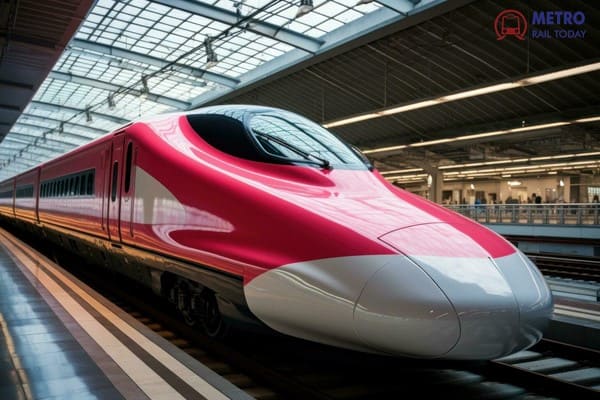
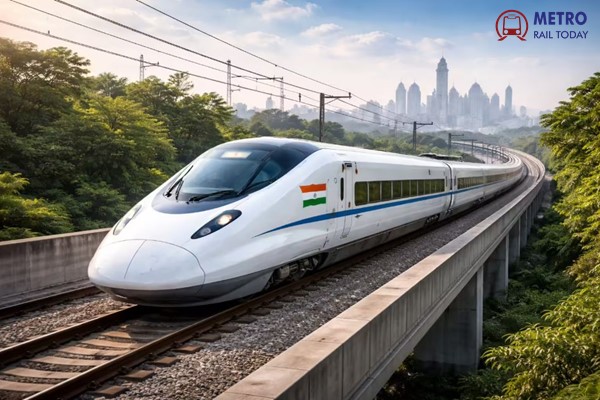
New Delhi, India (Rail & Metro Today): India is moving towards developing its own high-speed or bullet trains with a design speed of 350 kmph, with the indigenous B35 train targeted for development by 2030. The programme is being pursued alongside the ongoing development of India’s first indigenous B28 high-speed train, as the country seeks to build domestic capabilities in high-speed rolling stock, signalling and train-control technology.
The plan for the B35 trains was outlined by the Railway Ministry in its proposal for the revised cost of the Mumbai-Ahmedabad High-Speed Rail (MAHSR) project, which has now received Cabinet approval at more than ₹2 lakh crore.
The revised project cost is nearly twice the original estimate prepared in 2015. According to the ministry’s proposal, the escalation includes significant increases in land acquisition, infrastructure, rolling stock and signalling costs. Around ₹1 lakh crore of the escalated expenditure is proposed to be met through budgetary support.
India Begins Development of 350 kmph B35 Trains
The Railway Ministry has informed the Cabinet that the process to develop B35 high-speed trains has been initiated. The move followed discussions with Japan in December 2024 regarding the future availability of its E-series high-speed trains.
According to the ministry, Japan indicated that production of the existing E5 series would be phased out, while production of the next-generation E10 series would begin in 2030. The E10 trains are expected to be ready for operations by 2034.
Indian officials are expected to explore the deployment of E10 trains when they become available. At the same time, the development of the indigenous B35 trains represents a longer-term effort to establish domestic capability for high-speed rolling stock with a design speed of 350 kmph.
The development programme also extends beyond trains. India is working on its own Bharat Train Control System (BTCS), which is intended to provide indigenous train-control and signalling capabilities for the high-speed rail network.
B28 Trains to Begin the MAHSR Journey
The initial Mumbai-Ahmedabad High-Speed Rail operation will use B28 trains, which have a design speed of 280 kmph. Their maximum operating speed is stated at 249 kmph for the initial service.
BEML has received contracts to manufacture B28 trainsets, with two prototype trains expected to be ready for trial runs in the first quarter of 2027.
BEML has also received a separate ₹5,400-crore contract for 15 additional B28 trains, according to information supplied in the project update.
The development of the B28 trains is significant because it marks India's move towards domestic manufacturing of high-speed passenger trains rather than relying entirely on imported rolling stock.
MAHSR Cost Rises to More Than ₹2 Lakh Crore
The revised cost of the Mumbai-Ahmedabad High-Speed Rail project has increased substantially from the approximately ₹1.1 lakh crore estimate prepared in 2015.
The Railway Ministry has attributed a major portion of the increase to higher land acquisition costs, which have risen more than threefold to around ₹19,700 crore. Infrastructure expenditure has increased by nearly 50% to more than ₹1 lakh crore, while expenditure on trains and signalling systems has approximately doubled compared with the original estimate.
Excluding future Japanese trains, the current project cost works out to approximately ₹399 crore per km.
The 508-km Mumbai-Ahmedabad corridor remains the foundation of India’s high-speed rail programme. The complete corridor is targeted for completion by December 2030.
Developing an Indigenous High-Speed Rail Ecosystem
The B28 and B35 programmes are part of a wider effort to develop an Indian high-speed rail ecosystem covering rolling stock, signalling, train control and associated infrastructure.
The proposed Bharat Train Control System is particularly important in this context. The ministry's approach draws a parallel with China's development of its indigenous CTCS train-control technology, which is used for speed management, train spacing and safety across conventional and high-speed railway networks.
For India, developing domestic capabilities in these areas could reduce long-term dependence on imported technology and create opportunities for Indian manufacturers and engineering companies in future high-speed rail projects.
“The development of indigenous high-speed trains at 350 kmph represents an important technological ambition for India's railway sector. The B28 programme can provide the manufacturing and operational foundation for future generations of faster trains, while the proposed B35 platform and indigenous train-control technology can help build a more comprehensive domestic high-speed rail ecosystem. The success of this programme will depend not only on train manufacturing but also on sustained development of signalling, systems integration, testing, maintenance and specialised infrastructure capabilities,” said Mrs. Mamta Shah, MD & CEO, Urban Infra Group.
The Mumbai-Ahmedabad High-Speed Rail corridor is therefore emerging as more than a single railway project. Alongside the construction of the 508-km corridor, India is developing domestic capabilities in high-speed train manufacturing and train-control systems.
With B28 trains planned for the initial operation and B35 trains targeted for development by 2030, the programme could establish the technological foundation for India's future high-speed rail expansion. The availability of Japan's E10 trains from the mid-2030s may also provide another option for future operations, subject to subsequent decisions.
As India moves towards the completion of its first high-speed rail corridor, the combination of indigenous rolling stock, signalling technology and specialised infrastructure will be central to the country's ambition of creating a modern high-speed railway network.

MRT Online Desk
Metro Rail Today is an authentic and global news provider for the Rail & Metro industry from and around the world.