


Trending Now
 Alstom powers Delhi Metro's Pink and Magenta Line with Driverless Trains and CBTC Signalling
 South India's 744-km Chennai–Hyderabad Bullet Train Corridor set to transform connectivity
 TDC Contracting bags ₹92.10 Crore E&M Systems Contract for Chennai Metro Phase 2 Corridor 3
 Bids Invited for 5-Year Rolling Stock Maintenance Contract for Navi Mumbai Metro Line 1
 Madhya Pradesh plans to expand Indore Metro to Ujjain, Pithampur and Mhow
 Punjab approves 27-km long Pakistan’s first fully underground Lahore Blue Line Metro Project
 Tec4 Ingenieros-led JV appointed as Independent Engineer for ₹1,016 Crore BKC Pod Taxi Project
 MMRDA to appoint General Consultant for ₹4,063 Crore Mumbai Metro Line 5A Extension
 Railway proposes 50-Year Concession Period and Land Acquisition Support to boost PPP Projects
 BHEL vs Siemens, ABB and Medha: A Case Study in Technology Ownership and Industrial Strategy
Patna Metro achieves sixth Tunnel Breakthrough at PMCH Station on Corridor 2
MRT Online Desk
Posted on: 2025-07-30 15:30:00
Viewer: 6,979
Comments: 0
Country: India
City: Patna
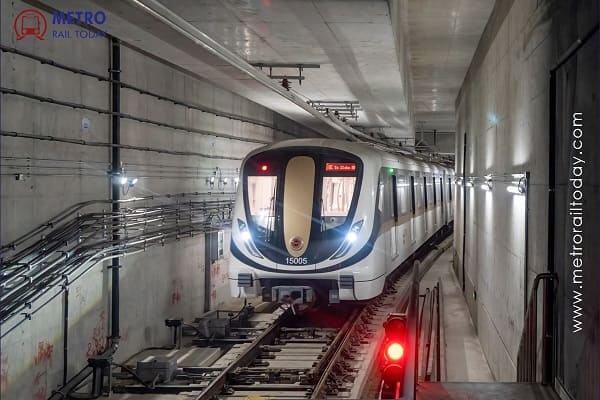
Patna, India (Metro Rail Today): The Patna Metro Rail Project reached a new construction milestone as Tunnel Boring Machine (DZ1091) deployed by Larsen & Toubro (L&T) achieved a successful breakthrough at the Patna Medical College and Hospital (PMCH) Station on Line 2, which spans 14.05 km, connecting Patna Junction Railway Station to the New ISBT. The breakthrough, which occurred under underground Package PC-03, marks the sixth successful tunnel breakthrough under this package and reinforces the project’s momentum toward timely completion.
TBM-2 (DZ1091), a 6.65-meter diameter Earth Pressure Balance (EPB) machine built by China Railway Construction Heavy Industry Co. Ltd. (CRCHI), was launched in July 2024 from Patna University Station. Over the course of 12 months, it bored a 1,068-meter-long up-line tunnel through dense urban terrain to reach PMCH Station. This marks the machine’s second successful drive for the Patna Metro project and highlights L&T’s technical capabilities in executing complex underground metro infrastructure.
The Delhi Metro Rail Corporation (DMRC), serving as the General Consultant for the project, awarded the ₹1,989 crore EPC contract for Package PC-03 to L&T in December 2021, with a 42-month completion timeline. Package PC-03 comprises 8 km of underground alignment on Line 2 between Rajendra Nagar and Patna Junction, including the design and construction of twin tunnels, cut-and-cover tunnels, and six underground metro stations: Rajendra Nagar, Moin Ul Haq Stadium, Patna University, PMCH, Gandhi Maidan, and Akashvani.
In June 2025, TBM-1 (DZ1090), working on the parallel down-line tunnel, had already achieved a successful breakthrough at PMCH Station, further advancing construction progress in the heart of Patna.
The twin breakthroughs by TBM-1 and TBM-2 at PMCH signal a high point in the underground construction phase, especially given the complex geology and urban density of the area. Notably, the construction required extreme precision to avoid disruption to heritage structures and active medical facilities in the vicinity.
Once completed, Line 2 of the Patna Metro will serve as the city’s core east-west corridor, significantly reducing travel time and providing a reliable, climate-resilient transport alternative. The entire Phase 1 of Patna Metro includes two corridors and is being developed at an estimated cost of over ₹13,500 crore, jointly funded by the Central and State governments, with financial assistance from multilateral agencies.
Commenting on the project’s progress, Mrs. Mamta Shah, MD & CEO of Urban Infra Group, said, “The sixth tunnel breakthrough at PMCH by L&T’s TBM is not just a technical feat, but a step closer to transforming Patna’s urban mobility landscape. With DMRC’s oversight and world-class engineering execution, the Patna Metro is poised to redefine how the city moves—efficiently, sustainably, and safely.”
The success of TBM-2 in Patna underscores the growing adoption of tunnel boring machines (TBMs) in India’s urban transit infrastructure, offering minimized surface disruption and faster underground transit deployment. As construction advances, the residents of Bihar’s capital can look forward to a modern, reliable, and transformative metro rail system that integrates seamlessly with the city’s future growth.


MRT Online Desk
Metro Rail Today is an authentic and global news provider for the Rail & Metro industry from and around the world.