


Trending Now
 GMRC to appoint General Engineering Consultants for Ahmedabad Metro Phase 2A, 2B & 3A
 Railway Ministry approves 220 kmph Next-Gen AI-enabled High Speed Trainsets for India
 GMRC issues first tender for Hybrid Metro–RRTS Corridors under Ahmedabad Metro Phase 3
 RITES delivers First Refurbished Metro Trainset to DMRC with advanced IP-Based Passenger System
 Uttarakhand Govt proposes extension of Delhi–Meerut RRTS Corridor to Haridwar and Rishikesh
- TBM assembly begins for India’s First Undersea Bullet Rail Tunnel in Mumbai
 Tender issued for 90 Rolling Stock Cars for Magenta Line Extension under Delhi Metro Phase IV
 Agra Metro completes system trial run on 6-km Mankameshwar–ISBT Stretch
 CRRC unveils Driverless CR151 Metro Train for Singapore’s Cross Island Line
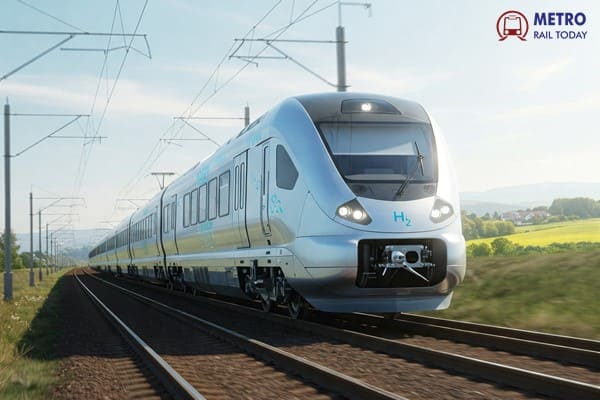 Alstom acquires Cummins Hydrogen Fuel Cell Unit to strengthen Hydrogen Train portfolio
Railway Ministry approves 220 kmph Next-Gen AI-enabled High Speed Trainsets for India
MRT Online Desk
Posted on: 2026-04-10 15:40:00
Viewer: 117
Comments: 0
Country: India
City: New Delhi
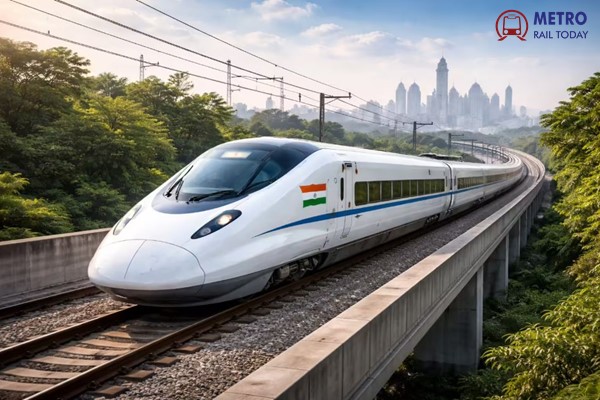
New Delhi, India (Metro Rail Today): In a major leap toward next-generation rail technology, the Ministry of Railways has approved the manufacturing of two advanced trainsets with a design speed of 220 kmph, surpassing the current Vande Bharat Express platforms designed for 180 kmph. The move signals Indian Railways’ continued push toward higher-speed, technology-driven passenger mobility.
According to official approvals issued by the Railway Board on March 23, 2026, two 16-car trainsets will be included in the Coach Production Programme for 2027–28. These broad-gauge trainsets will feature steel-bodied coaches, with a maximum operational speed of 200 kmph, positioning them among the fastest conventional trains in India.
Building on Vande Bharat Success
The development builds upon the success of the Vande Bharat programme, with 81 pairs of chair car services currently operational across the Indian Railways network. The new trainsets are expected to incorporate enhanced design, safety and performance features, further elevating passenger experience and operational efficiency.
Earlier, in October 2024, the Integral Coach Factory (ICF) had awarded a contract to BEML for the design, manufacture and commissioning of two high-speed trainsets comprising eight cars each. The contract, valued at ₹866.87 crore, reflects growing collaboration between public sector units to develop indigenous high-speed solutions.
Commenting on the development, Mrs. Mamta Shah, MD & CEO, Urban Infra Group, said, “The approval of 220 kmph trainsets marks a significant evolution in India’s rail manufacturing capabilities. It demonstrates a clear transition toward higher-speed, technologically advanced train systems that can compete with global benchmarks while strengthening indigenous production under the Make in India initiative.”
Modern Manufacturing Backbone
India’s coach manufacturing ecosystem continues to play a crucial role in this transformation. Facilities such as the Integral Coach Factory in Chennai, Rail Coach Factory in Kapurthala and Modern Coach Factory in Raebareli are actively producing a diverse range of rolling stock, including Vande Bharat trains, metro coaches, regional rapid transit systems and Amrit Bharat trains.
The addition of next-generation high-speed trainsets will further strengthen this ecosystem and support the country’s long-term rail modernisation goals.
Adoption of Composite Sleepers for Better Performance
In parallel with rolling stock advancements, Indian Railways has approved the use of composite sleepers at bridge approaches and at points and crossings. These sleepers are lighter than conventional materials, offer improved cushioning and can withstand higher loads of up to 700 kg per square centimetre.
The adoption of composite sleepers is expected to enhance ride quality, particularly over critical track sections, while also reducing maintenance requirements due to their longer lifespan and adaptability to location-specific needs.
AI and Advanced Testing to Enhance Safety
Further strengthening its focus on safety and predictive maintenance, Indian Railways has decided to introduce Artificial Intelligence-based track monitoring systems. AI-enabled inspection vehicles equipped with Ground Penetration Radar will assess track conditions, enabling early detection of potential issues.
Additionally, Magnetic Particle Testing will be deployed to improve the quality of welded joints in railway tracks. This advanced technique allows for the identification of minute defects, ensuring higher safety standards and operational reliability.
With simultaneous advancements in rolling stock, track infrastructure and digital monitoring systems, Indian Railways is moving toward a future defined by speed, safety and sustainability. The introduction of 220 kmph trainsets, coupled with smart maintenance practices, represents a decisive step in transforming India’s rail network into a world-class transportation system.


MRT Online Desk
Metro Rail Today is an authentic and global news provider for the Rail & Metro industry from and around the world.