

Trending Now
 Paras Railtech wins ₹84.72 crore Ballastless Track Contract for Jaipur Metro Rail Project
 Indian Railways announces 3,548 Graduate-Level Vacancies under NTPC Recruitment 2026
 European Union sanctions €10 million to support extension of Hanoi Metro Line 3
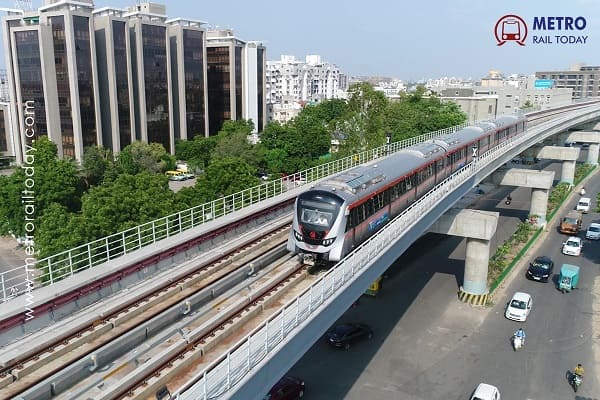 GMRC issues ₹683 crore Tender for construction of 8.68 km stretch for Ahmedabad Metro
- GMRC launches ₹439 crore Tender for construction of 5 New Ahmedabad Metro Stations
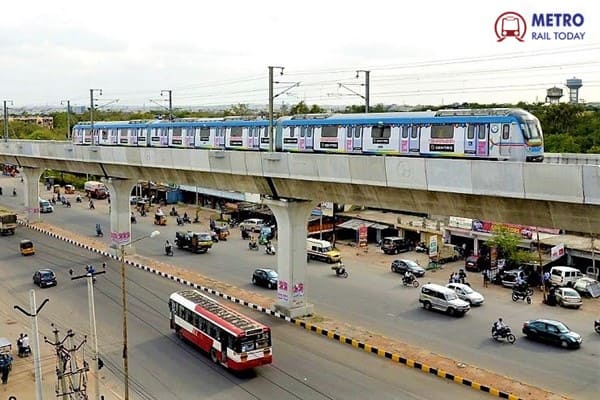 Global tender issued for procurement of 60 Rolling Stock coaches for Hyderabad Metro Rail Project
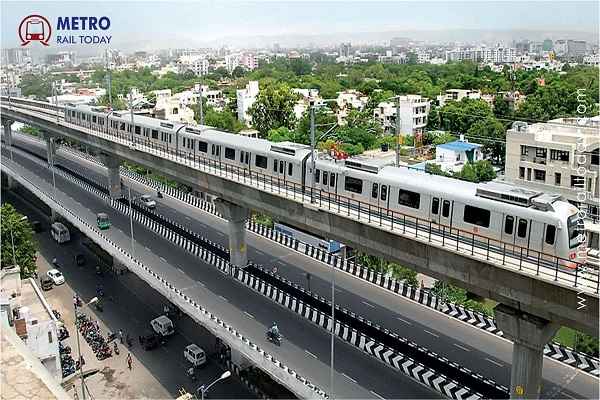 Global tender issued for procurement of 102 Rolling Stock coaches for Patna Metro Rail Project
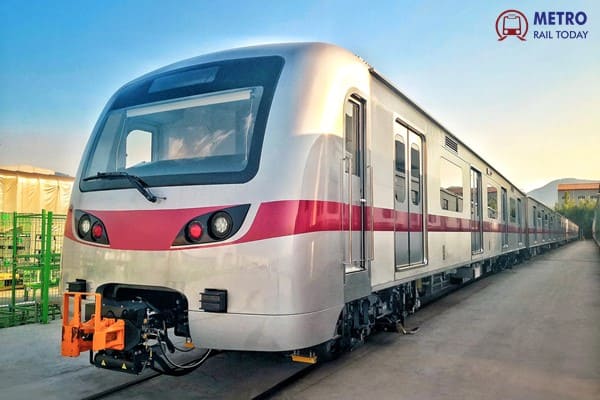 Gamuda awarded RM3.7 billion contract to build Keelung Mass Rapid Transit in Taiwan
 Maharashtra forms special Task Force to plan Rail, Metro and RRTS expansion
 Govt. of India approves ₹12,200 crore, 29-km Thane Integral Ring Metro project in Maharashtra
Union Railway Minister shares update on proposed Delhi-Varanasi-Patna Bullet Train Corridor
MRT Online Desk
Posted on: 2026-09-01 16:47:00
Viewer: 1,854
Comments: 0
Country: India
City: New Delhi
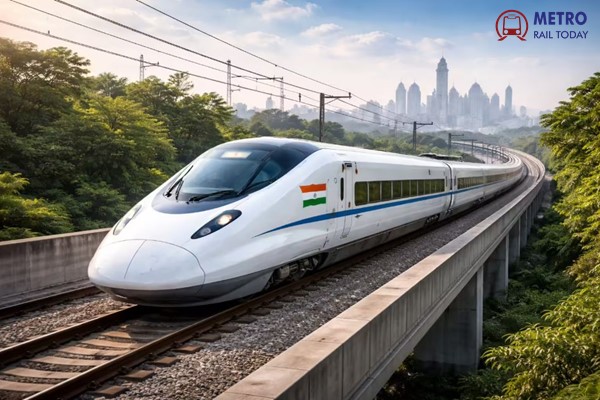
New Delhi, India (Rail & Metro Today): Union Railway Minister Ashwini Vaishnaw has outlined the proposed travel times for a future Delhi–Varanasi–Patna high-speed rail corridor, which could connect the national capital with major cities across Uttar Pradesh and Bihar at speeds comparable to the Mumbai-Ahmedabad bullet train project.
Under the proposed high-speed rail network, travel from Delhi to Lucknow could take around two hours, while Delhi to Patna could be covered in approximately 4.5 hours, the minister said on Monday.
The proposed bullet train corridor would connect Delhi with Agra, Kanpur, Lucknow, Prayagraj, Varanasi and Patna, creating a major high-speed rail link across northern and eastern India.
Vaishnaw made the remarks while speaking virtually during the inauguration of the newly converted and electrified broad-gauge railway line on the Nepalganj Road–Nanpara–Bahraich section.
Proposed Delhi-Patna Bullet Train Travel Times
According to the travel time estimates shared by the Railway Minister, the proposed high-speed rail network could significantly reduce journey times between Delhi and several major cities.
The estimated travel time between Delhi and Agra, a distance of around 200 km, would be approximately 58 minutes. The journey to Kanpur, located around 455 km from Delhi, could take 1 hour and 50 minutes, while the 495-km journey to Lucknow could be completed in about 2 hours and 12 minutes.
A proposed high-speed train journey between Delhi and Prayagraj, covering approximately 750 km, could take around three hours. Travel to Varanasi, approximately 945 km from Delhi, is estimated at about 3 hours and 33 minutes.
The proposed 1,170-km journey from Delhi to Patna could be completed in approximately 4.5 hours.
“If the project materialises, it will be the next phase bullet train corridor in the country after the Mumbai-Ahmedabad corridor and the first to connect the National Capital with many cities of Uttar Pradesh and Bihar,” Vaishnaw said.
Major Boost for Uttar Pradesh and Bihar Connectivity
The proposed Delhi high-speed rail corridor could emerge as a major infrastructure development for Uttar Pradesh and Bihar, connecting some of the country's most important industrial, commercial, historical and religious centres.
Beyond faster intercity travel, the corridor is expected to support tourism, business and wider economic activity across the Delhi–Uttar Pradesh–Bihar belt. Cities and religious destinations such as Agra, Prayagraj, Varanasi and Patna could particularly benefit from significantly improved rail connectivity.
The proposal could also provide an important high-capacity alternative to existing road and conventional railway services, although the project will need to progress through the detailed planning, approval and implementation stages before construction can begin.
Mrs. Mamta Shah, MD & CEO, Urban Infra Group, said, “The proposed Delhi–Patna high-speed rail corridor has the potential to transform connectivity across one of India's most economically and culturally important regions. By bringing major cities in Uttar Pradesh and Bihar within a few hours of the national capital, the project could strengthen regional economies, tourism and business connectivity while creating a new benchmark for intercity mobility in northern India.”
India’s Second Major High-Speed Rail Network
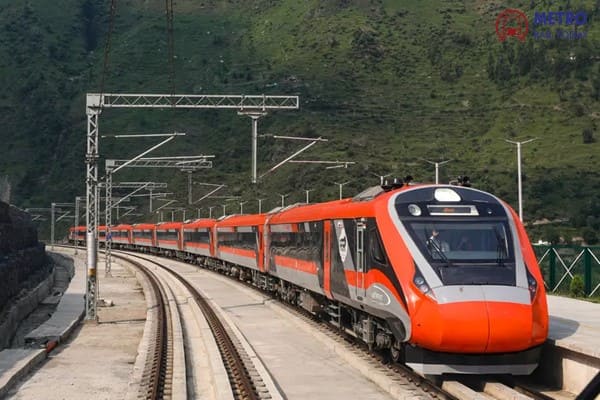
India's current railway network operates trains at speeds considerably lower than those proposed for dedicated high-speed rail. The Vande Bharat Express, India's flagship semi-high-speed service, operates on a network with a maximum design speed of around 180 kmph.
In comparison, the Mumbai-Ahmedabad High-Speed Rail (MAHSR) Project is being developed with a design speed of 350 kmph and an operational speed of 320 kmph. The project is expected to reduce travel time between Mumbai and Ahmedabad to approximately 1 hour and 58 minutes.
The first high-speed rail service in India is expected to commence in August 2027, with the initial operational section planned between Surat and Vapi.
The proposed Delhi–Agra–Kanpur–Lucknow–Prayagraj–Varanasi–Patna corridor would therefore represent the next major phase of India's high-speed rail ambitions, if it receives the necessary approvals and progresses to implementation.
A high-speed rail link across this corridor would not only reduce travel times dramatically but could also establish a new model for connecting India's large population centres through dedicated, modern rail infrastructure. As India moves forward with the Mumbai-Ahmedabad bullet train project, the proposed Delhi–Patna high-speed rail corridor is expected to become one of the most closely watched future railway infrastructure proposals in the country.


MRT Online Desk
Metro Rail Today is an authentic and global news provider for the Rail & Metro industry from and around the world.