

Trending Now
 Paras Railtech wins ₹84.72 crore Ballastless Track Contract for Jaipur Metro Rail Project
 Indian Railways announces 3,548 Graduate-Level Vacancies under NTPC Recruitment 2026
 European Union sanctions €10 million to support extension of Hanoi Metro Line 3
 GMRC issues ₹683 crore Tender for construction of 8.68 km stretch for Ahmedabad Metro
- GMRC launches ₹439 crore Tender for construction of 5 New Ahmedabad Metro Stations
 Global tender issued for procurement of 60 Rolling Stock coaches for Hyderabad Metro Rail Project
 Global tender issued for procurement of 102 Rolling Stock coaches for Patna Metro Rail Project
 Gamuda awarded RM3.7 billion contract to build Keelung Mass Rapid Transit in Taiwan
 Maharashtra forms special Task Force to plan Rail, Metro and RRTS expansion
 Govt. of India approves ₹12,200 crore, 29-km Thane Integral Ring Metro project in Maharashtra
India commissions 1,506-km dedicated freight railway corridor connecting JNPA to New Dadri
MRT Online Desk
Posted on: 2026-09-08 17:00:00
Viewer: 2,565
Comments: 0
Country: India
City: New Delhi
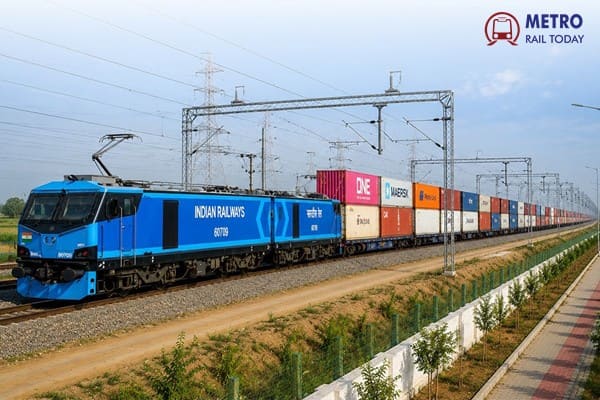
New Delhi, India (Rail & Metro Today): Prime Minister Narendra Modi on September 8, 2026, inaugurated the final three sections of the Western Dedicated Freight Corridor (WDFC), completing the 1,506-km freight railway corridor connecting New Dadri in Uttar Pradesh with New JNPT in Maharashtra. The milestone provides the Jawaharlal Nehru Port Authority (JNPA) with a direct dedicated freight rail connection to northern India and marks a major step forward in transforming India’s logistics and freight transportation network.
The three newly commissioned sections — New Saphale–New JNPT, New Umbergaon–New Saphale and New Sanand (North)–New Makarpura — collectively cover approximately 326 km and have been developed at a cost of around ₹20,700 crore. Prime Minister Modi inaugurated the sections from Vadodara through video conferencing. Maharashtra Governor Jishnu Dev Varma, Chief Minister Devendra Fadnavis and Deputy Chief Ministers Eknath Shinde and Sunetra Pawar attended the event at JNPA.
India’s 2,843-km Dedicated Freight Corridor Network Completed
With the commissioning of these sections, the country’s entire 2,843-km Dedicated Freight Corridor network is now operational. The network comprises the 1,506-km Western DFC and the 1,337-km Eastern DFC, creating a dedicated high-capacity freight backbone between major industrial, consumption and port regions.
The two corridors currently carry around 443 freight trains every day, significantly improving the capacity and efficiency of freight transportation while separating goods traffic from passenger train operations on conventional railway routes.
Speaking at the inauguration, Prime Minister Narendra Modi highlighted the transformation brought about by dedicated freight infrastructure.
“Earlier, passenger trains and goods trains ran on the same track. The DFC has changed this… This corridor, these goods trains – fuel is saved, fare is saved, time is saved and the environment benefits.”
Calling the completion of the Eastern and Western DFCs a historic achievement for 21st-century India, Modi said the corridors had become a major foundation for the country’s trade and an important component of the journey towards Viksit Bharat. He also linked the project with the government’s PM Gati Shakti initiative aimed at strengthening multimodal connectivity and reducing logistics bottlenecks.
Faster Freight Movement and Lower Logistics Costs
The Dedicated Freight Corridor has substantially improved freight transit times. According to the Prime Minister, the time required to cover 100 km has reduced from around 6.5 hours to nearly half, while cargo that could take nearly 30 hours by road in suitable cases can move through the dedicated freight network in approximately 10–12 hours.
The higher speed and reliability of freight movement are also expected to benefit the agricultural sector. Faster transportation can help fruits, vegetables, flowers and other perishable commodities reach markets more efficiently, reducing transit-related losses and improving access to wider markets.
A key feature of the WDFC is its capability to operate double-stack container trains, enabling significantly higher freight volumes per train. Prime Minister Modi referred to a double-stack service between JNPA and Vadodara that can carry cargo equivalent to more than 250 trucks, demonstrating the corridor’s potential to shift substantial freight from road to rail.
JNPA Set to Gain Major Strategic Advantage
Maharashtra Chief Minister Devendra Fadnavis described the commissioning of the final WDFC sections as a “revolution in the country’s logistics sector”, with JNPA expected to emerge as one of the biggest beneficiaries.
According to Fadnavis, cargo that earlier took around three days could now move between key destinations in approximately 12 hours. The operation of nearly one-kilometre-long double-stack freight trains is also expected to reduce fuel consumption, pollution and road congestion.
Fadnavis further highlighted the potential impact on India's logistics competitiveness. He said India's logistics cost, which was around 14% of GDP, had declined to approximately 10% over the past decade and could potentially move closer to 7% with the development of infrastructure such as the DFC. Lower logistics costs would strengthen India's ability to compete with China and participate more effectively in global supply chains.
For Maharashtra, the WDFC’s direct connectivity to JNPA is particularly significant. Fadnavis said the port could handle more than one million TEUs, strengthening its role as a gateway for India's international trade. Improved freight connectivity is expected to support export-oriented industries in Maharashtra, enhance their global competitiveness and contribute to employment generation.
A New Backbone for India’s Freight Economy
The completion of the DFC network represents a fundamental shift in India's freight transportation strategy. By creating dedicated, high-capacity rail infrastructure for goods movement, the corridors can allow conventional railway routes to focus more effectively on passenger services while providing freight operators with faster and more predictable transportation.
“The full commissioning of the Eastern and Western Dedicated Freight Corridors marks a transformational moment for India's logistics ecosystem. Direct connectivity between major industrial regions and ports, combined with double-stack operations and faster transit times, can significantly improve supply-chain efficiency and strengthen the competitiveness of Indian industry,” said Mrs. Mamta Shah, MD & CEO, Urban Infra Group.
The operational DFC network is expected to play an increasingly important role in India's multimodal logistics architecture, supporting industrial growth, port-led development, agricultural supply chains and the broader objective of creating a more efficient and globally competitive freight transportation system.
With the Western and Eastern corridors now fully operational, India has established a dedicated freight backbone of 2,843 km, laying a stronger rail-based foundation for the country's long-term logistics growth and the Viksit Bharat @ 2047 vision.


MRT Online Desk
Metro Rail Today is an authentic and global news provider for the Rail & Metro industry from and around the world.