

Trending Now
 Japanese Delegation visits KRIDE to explore Bengaluru Suburban Rail Project opportunities
 GMRC issues ₹879 crore Civil Tender for Airport Extension under Ahmedabad Metro Phase 2A
 Global Mobility Leaders Alstom and Siemens become Corporate Member of Chamber of Railway Industries
 L&T-MHI JV wins contract for Automated People Mover at Dubai’s Al Maktoum International Airport
 Delhi Metro Rail Network to expand to 695 km by 2047, Six new RRTS Corridors planned
 HÜBNER at InnoTrans 2026: Global rail expertise and local capability for India’s Next-Gen Mobility
 Australia shortlists three firms/consortia for Sydney–Newcastle High Speed Rail Project
 MRVC set to procure 238 AC Vande Metro Trainsets worth ₹19,293 crore from Indian Railways
 Maharashtra approves ₹17,725 crore Mumbai Metro Line 13 linking Mira-Bhayandar with Vasai-Virar
 Gujarat issues three tenders for 48.38-km Metro-RRTS Hybrid corridors under Ahmedabad Metro Phase 3
NCRTC achieves First Tunnel Breakthrough of Delhi-Meerut RRTS in Delhi section
MRT Online Desk
Posted on: 2023-04-08 13:00:00
Viewer: 1,640
Comments: 0
Country: India
City: New Delhi
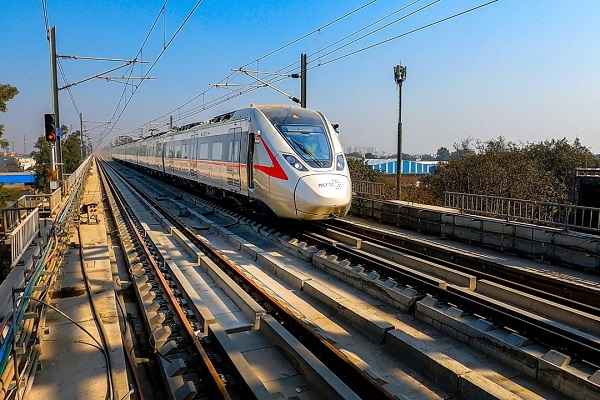
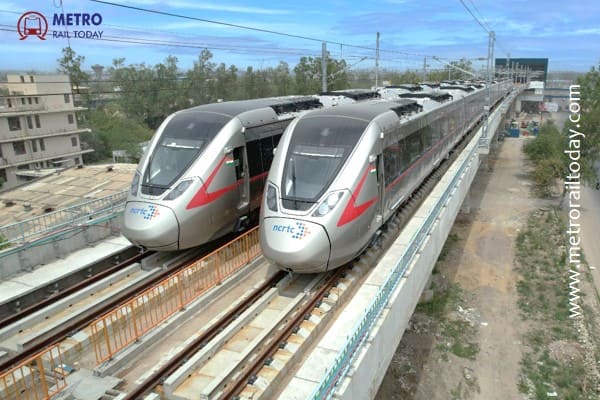
New Delhi, India (Metro Rail Today): The National Capital Region Transport Corporation Ltd (NCRTC) has today achieved its first Tunnel breakthrough for the Delhi section of the Delhi - Ghaziabad - Meerut RRTS corridor. The Tunnel Boring Machine (TBM), Sudarshan 4.1 made the breakthrough from the tunnel retrieval shaft constructed at Khichdipur, Delhi.
The tunnel breakthrough was recorded in presence of Manoj Joshi, Secretary, Ministry of Housing and Urban Affairs, Govt. of India; Vinay Kumar Singh, Managing Director, NCRTC, Directors and other senior officials of NCRTC and contractors.
The first TBM of Delhi section, ‘Sudarshan 4.1’, was lowered at the Anand Vihar launching shaft in January 2022 for the construction of RRTS tunnels between Anand Vihar and Khichdipur. This RRTS tunnel is the longest tunnel in Delhi made by any Tunnel Boring Machine and is about 3 kilometres long. RRTS tunnels have a diameter of 6.5 metre which is highly optimised as compared to global benchmarks of tunnels for similar design speed of 180 Kmph with wider and higher rolling stock.
A total of 4 tunnels are being constructed in Delhi for the 82-kilometre Delhi – Ghaziabad – Meerut RRTS corridor for to and from movement in both directions. Two parallel tunnels of about 3 kilometers long between Anand Vihar to Khichdipur towards New Ashok Nagar RRTS station and about 2 kilometer long parallel tunnels from Anand Vihar to Vaishali towards Sahibabad RRTS Station.
This is the first tunnel which has been completed in the Delhi section from Anand Vihar to Khichdipur. The other TBM ‘Sudarshan 4.2 has completed tunnelling of about 2.5 kilometer in the same direction. On the other hand, Sudarshan 4.3 and 4.4 are boring tunnels in the direction of Sahibabad from Anand Vihar and have completed the construction of more than 1.5 kilometres and 1 kilometre respectively.
Speaking on the occasion, Secretary, MoHUA while congratulating NCRTC said, “RRTS is aimed to ease regional mobility in NCR thereby reducing vehicular congestion on roads and lowering air pollution. Multi-modal integration has been one important consideration while planning and implementing RRTS. I am confident that it will enhance the quality of life in NCR.”
On this occasion, Vinay Kumar Singh, MD, NCRTC said, “I compliment the engineers of NCRTC as well as our construction partner for completing this section of tunnelling which was a complex and challenging task. Going towards New Ashok Nagar, it has negotiated very close to existing metro station piling structues in addition to foundations of expressways and non-engineered buildings in Patparganj and Khichdipur. NCRTC has prioritised commuters’ convenience over ease of construction. Sarai Kale Khan and Anand Vihar RRTS station are examples of extensive multi-modal integration which will enable seamless transfers to stations of Indian Railways, ISBTs, City Bus as well as Metro.”
To construct this 3 kilometer long RRTS tunnel, more than 14000 high-preciion pre-casted tunnel segments have been used which will ensure a long tunnel life. The Tunnel Segments of Delhi section are being casted at NCRTC's Casting Yard established at Karkardooma, Delhi.
NCRTC is targeting to commission the entire 82 km long Delhi-Ghaziabad-Meerut for the public by 2025. Before that, it will operationalise a 17-km long Priority Section between Sahibabad and Duhai shortly, before the scheduled time.


MRT Online Desk
Metro Rail Today is an authentic and global news provider for the Rail & Metro industry from and around the world.