


Trending Now
 NV Dynamics awarded Noise and Vibration Study contract for Jaipur Metro Phase 2 Project
 Two global consortia bid for India’s 350 kmph High-Speed Rail Design consultancy contract
 Larsen & Toubro (L&T) extends Hyderabad Metro stake sale timeline to 31 December 2026
 Haryana Govt approves ₹1,662 crore construction tender for Gurugram Metro Phase 2
 Hyundai Rotem Targets Fully Autonomous Hydrogen Trams by 2031
 TBM Kaveri records Tunnel Breakthrough at KMC Station for Chennai Metro Phase 2
 China opens four High-Speed Railway Lines, Adds 1,142 km to existing Bullet Train Network
 AECOM appointed as Detailed Design Consultant for Ahmedabad Metro Phase 3A
 Asa Bhanu wins ₹40.59 crore Rolling Stock Maintenance Contract for Nagpur Metro Rail Project
 Kolkata Metro: From India’s First Metro to a 73.42-km Multi-Corridor Metro Rail Network
BEML sets timeline for production of high speed trainsets for India's first Bullet Train project
MRT Online Desk
Posted on: 2025-12-29 08:20:00
Viewer: 6,648
Comments: 0
Country: India
City: Bengaluru
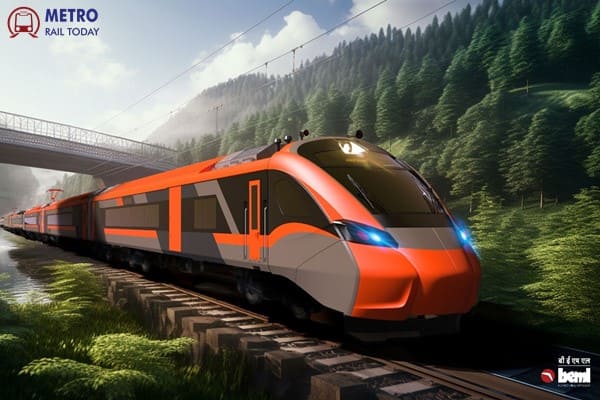
Bengaluru, India (Metro Rail Today): India’s journey toward technological self-reliance in advanced rail systems has taken a decisive leap forward, with BEML Limited developing its upcoming indigenous BEML High Speed Trainset (Train-B28) for the Mumbai–Ahmedabad High Speed Rail Corridor. The project marks a milestone in India’s efforts to design, manufacture and validate world-class high-speed rail technology within the country, reducing dependence on imports and strengthening domestic manufacturing.
Two 8-coach indigenous high-speed trainsets are currently under development and will be deployed primarily for trial runs on India’s first bullet train corridor. The programme not only accelerates India’s high-speed rail ambitions but also lays the foundation for a complete homegrown HSR ecosystem spanning design, manufacturing, testing, and certification.
Mock-Up in 2026, Trial Trainsets by 2027
BEML is following a phased development strategy to ensure reliability and rigorous validation before commercial deployment.
-
Q1 2026 – unveiling of the full-scale mock-up
-
Q4 2026 – rollout of the first complete trainset
-
2027 – rollout of the second trainset
-
Post-2027 – extensive trial operations on the Mumbai–Ahmedabad corridor
This deliberate sequencing allows sufficient time for dynamic trials, homologation, safety validation, and system integration, all of which are essential for high-speed rail operations.
Speed & Performance: Designed for 280 kmph
The BEML High Speed Trainset has been engineered to meet global benchmarks in speed, comfort and safety.
-
Design / test speed: 280 kmph
-
Operational speed: 249 kmph
-
Average daily running capability: nearly 2,000 km per day
-
Service braking: 0.8 m/s²
-
Emergency braking jerk: 1 m/s³
These parameters ensure both operational efficiency and high safety margins, while the performance profile aligns with international bullet train standards.
Distributed Power Configuration for Faster Acceleration
The trainset adopts an 8-car distributed power configuration, comprising:
-
Driving trailer cars at both ends
-
Multiple motor and trailer coaches in between
This architecture improves:
-
acceleration
-
redundancy
-
ride stability
-
energy efficiency
The formation includes:
-
Standard passenger coaches
-
A dedicated Executive Class coach
-
Facilities for Persons with Reduced Mobility (PRM)
-
Bi-directional operation capability
The train will run on standard gauge and complies with EN-12663 structural standards, ensuring compatibility with global safety requirements.
Built for India: Heat, Dust, Salinity and Monsoons
Unlike many imported high-speed systems designed for milder climates, the BEML trainset has been engineered around Indian environmental realities.
It is designed to operate between –5°C to 50°C and withstand heavy monsoon rainfall and flooding, desert dust and sand conditions, saline coastal environments, and high wind loads.
This environmental resilience significantly reduces maintenance burden and downtime under Indian conditions.
Advanced Manufacturing and Stringent Quality Testing
BEML is adopting advanced manufacturing approaches including:
-
lightweight steel and stainless-steel bodies
-
epoxy aluminium honeycomb sandwich panels for panels and covers
-
aerodynamic shaping validated for 280 kmph loads
Welding and testing approaches include:
-
laser welding
-
TIG and MIG/MAG welding
-
100% non-destructive testing, such as:
-
ultrasonic
-
radiography
-
magnetic particle testing
-
Full carbody squeeze and structural testing will be carried out at BEML’s Bengaluru facility in 2026, with independent third-party validation of structural strength and weld integrity.
Strategic Significance for India
The Train-B28 programme aligns with:
-
Make in India
-
Atmanirbhar Bharat
-
indigenization of critical technologies
-
development of export-capable rail manufacturing ecosystems
It reduces reliance on technology transfer–based procurement models and helps India graduate from rolling stock assembler to technology developer.
“The development of BEML’s indigenous high-speed trainset is not just a rolling-stock project; it is a strategic technology milestone for India,” said Mrs. Mamta Shah, MD & CEO, Urban Infra Group. “It demonstrates the capability of Indian engineers and manufacturers to operate at the frontiers of rail technology and sets the foundation for an indigenous high-speed rail ecosystem that will power the country’s mobility transformation over the coming decades.”
With the BEML High Speed Trainset, India is not merely building a bullet train — it is building domestic competence across high-speed rolling stock design, advanced manufacturing, testing and certification capability, and climate-adaptive engineering.
As the Mumbai–Ahmedabad High Speed Rail corridor progresses, Train-B28 positions India among the select nations capable of designing world-class high-speed rail technology at home.


MRT Online Desk
Metro Rail Today is an authentic and global news provider for the Rail & Metro industry from and around the world.
